
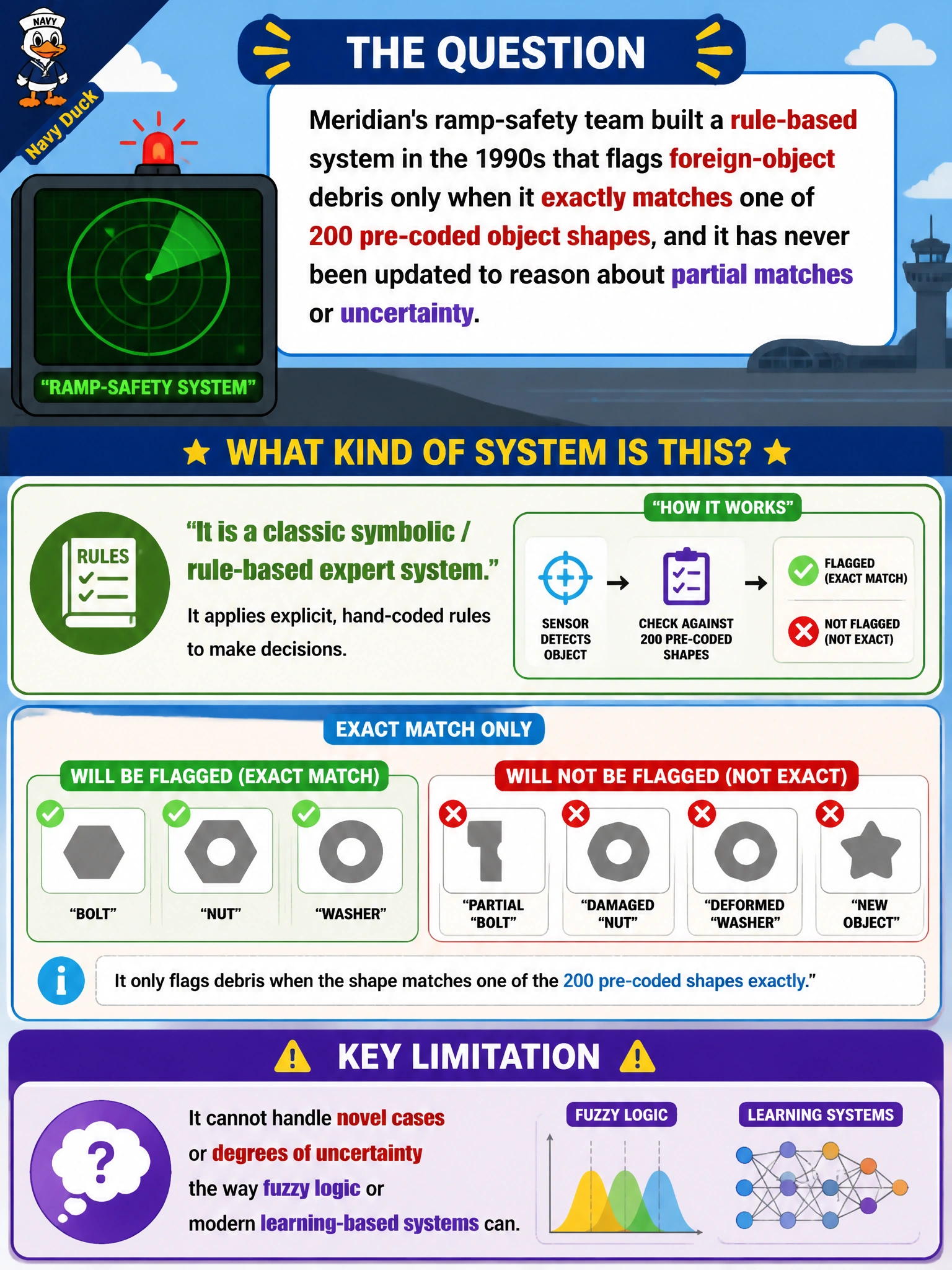
Meridian's ramp-safety team built a rule-based system in the 1990s that flags foreign-object debris only when it exactly matches one of 200 pre-coded object shapes, and it has never been updated to reason about partial matches or uncertainty. What kind of system is this, and what is its key limitation?
Select an answer to reveal the explanation.
Short Explanation
A system that only recognizes exact pre-coded shapes is a rules-following expert system, not a learner — it's brittle by design. Fuzzy logic and modern models exist precisely to handle the 'almost matches' cases this old system was built to ignore.
Full Explanation
CPMAI Task 1 asks candidates to recognize symbolic systems, expert systems, and fuzzy logic as related but distinct AI concepts. A system driven by 200 hand-coded exact-match rules is a symbolic/expert system: it encodes human expert knowledge as explicit rules and executes them deterministically, which is exactly why it is reliable on known cases but brittle on anything outside its coded rule set — it cannot reason about partial matches or degrees of confidence, which is what fuzzy logic (or a modern learned model) would add. The reinforcement-learning distractor is wrong because nothing in the scenario describes an agent taking actions, receiving rewards, and exploring an environment — it's a static rule matcher, not a learning agent. The generative-AI/hallucination distractor misapplies a large-language-model failure mode (fabricating plausible-sounding but false output) to a rigid rule-matcher, which by design cannot 'invent' a match — it either matches a coded shape or does not. The unsupervised-clustering distractor is wrong on the mechanism (there is no clustering of unlabeled data happening) and also on the stated limitation (explainability is generally a strength of rule-based systems, not a weakness, since every decision traces to an explicit rule). The correct diagnosis — brittle symbolic system — points the PM toward augmenting or replacing it with pattern-recognition AI rather than adding more hand-coded rules.