
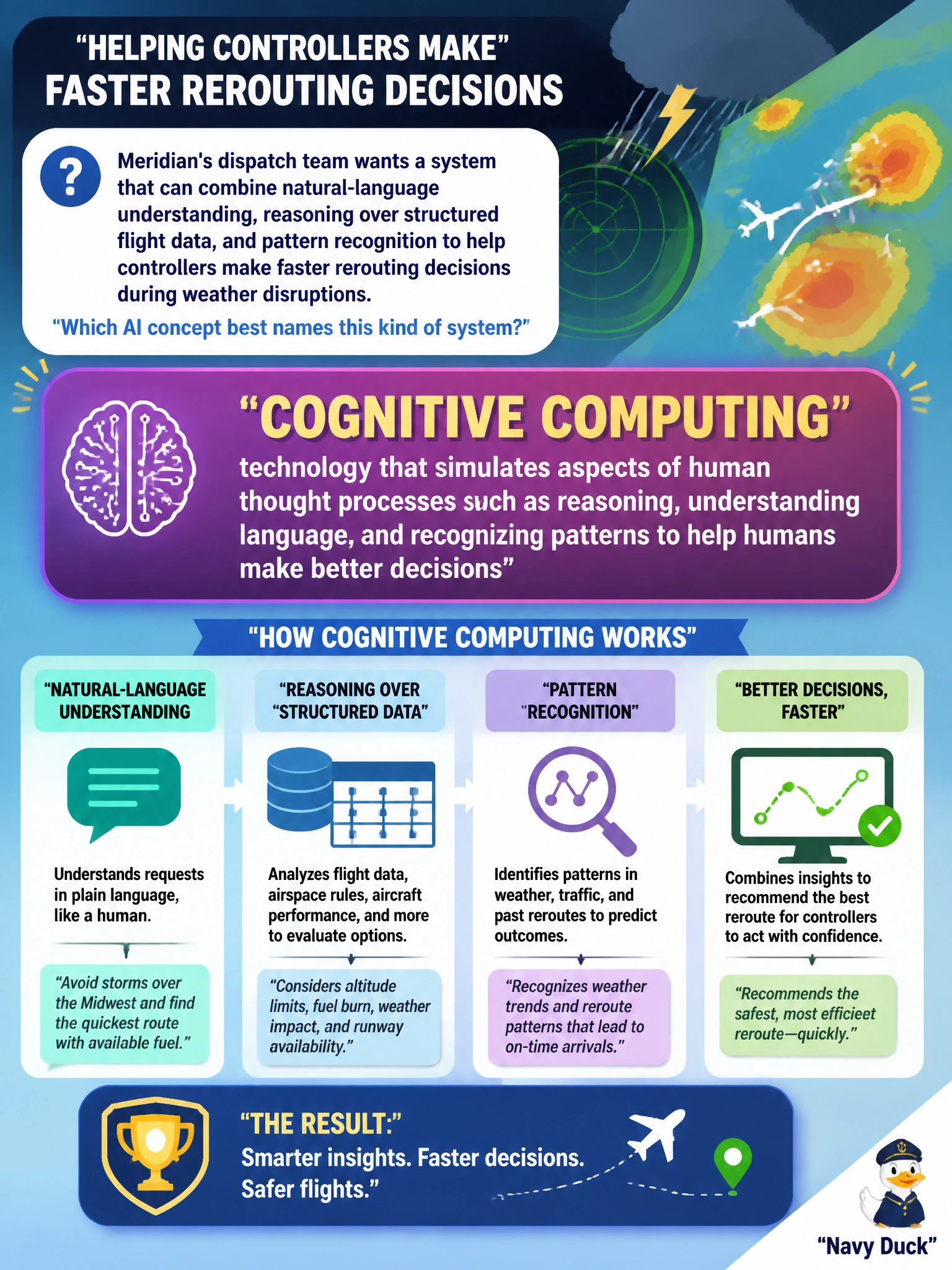
Meridian's dispatch team wants a system that can combine natural-language understanding, reasoning over structured flight data, and pattern recognition to help controllers make faster rerouting decisions during weather disruptions. Which AI concept best names this kind of system?
Select an answer to reveal the explanation.
Short Explanation
Cognitive computing is the umbrella term for 'machine that reasons, understands language, and spots patterns, together, to help a human decide' — that's exactly a dispatcher's rerouting assistant. RPA is just clicking buttons faster; that's not this.
Full Explanation
Cognitive computing describes systems designed to simulate human thought processes — reasoning, natural-language understanding, pattern recognition — in service of augmenting human decision-making, which matches the dispatch rerouting assistant precisely: it blends language understanding, structured-data reasoning, and pattern recognition to support (not replace) the controller's call. RPA is the wrong label because RPA automates repetitive, rule-based workflow steps without the reasoning or language-understanding blend described here — it is a related but narrower CPMAI concept (Task 2). A 'pure expert system' is too narrow too: expert systems apply a fixed rule base and lack the natural-language and pattern-recognition blend that defines cognitive computing, even though expert systems are one of cognitive computing's historical building blocks. Fuzzy logic is a specific mathematical technique for handling degrees of truth/uncertainty (useful in cognitive systems) but is not itself the umbrella concept, and it is not uniquely responsible for natural-language handling. Recognizing cognitive computing as the parent concept helps the PM scope vendor requirements correctly: the dispatch tool needs a multi-capability cognitive architecture, not a single-technique tool.