
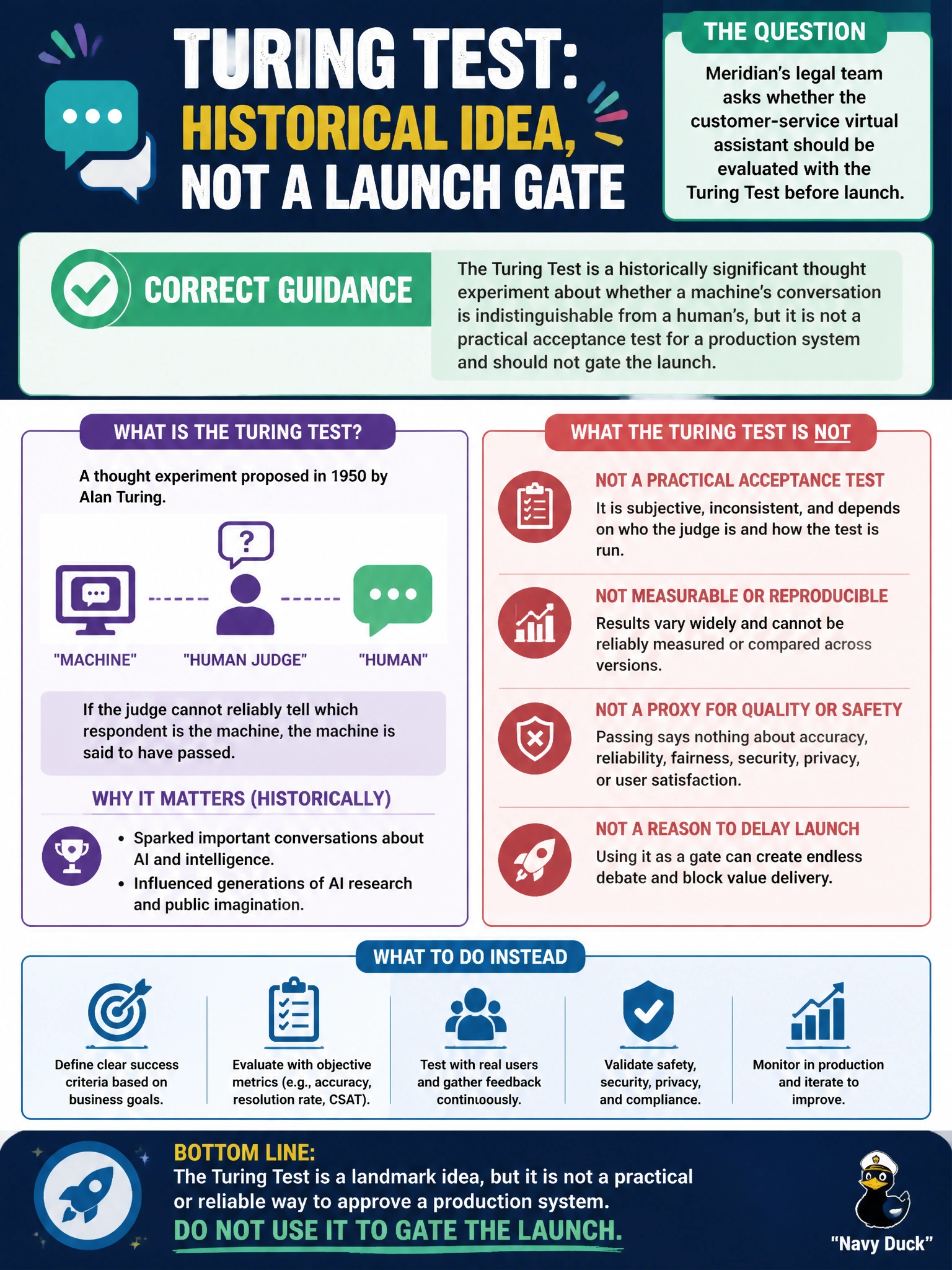
Meridian's legal team asks whether the customer-service virtual assistant should be evaluated with the Turing Test before launch. What is the correct guidance on the Turing Test's role here?
Select an answer to reveal the explanation.
Short Explanation
The Turing Test is famous, not functional — it's a philosophy-class thought experiment ('could you tell it's a machine?'), not a checklist item your QA team runs. For go-live, Meridian needs real acceptance criteria: resolution rate, escalation accuracy, safety guardrails.
Full Explanation
CPMAI expects candidates to know the Turing Test's significance as a historical and conceptual milestone in AI evaluation — Alan Turing's proposal that a machine could be judged intelligent if its conversation was indistinguishable from a human's — while also knowing its practical limits. It is not a certification requirement, not a statistical accuracy metric, and not proof of AGI; passing it demonstrates conversational mimicry, not general reasoning or legal fitness for deployment. The 'legally required certification' distractor invents a regulatory requirement that does not exist for airline chatbots. The 'training accuracy against a validation dataset' distractor confuses the Turing Test with ordinary machine-learning evaluation metrics (precision, recall, accuracy) — a separate, genuinely useful acceptance-testing practice the project should use instead. The 'proves AGI' distractor overstates what indistinguishable conversation demonstrates; fooling a human in dialogue says nothing about general task-independent reasoning. For Meridian's rebooking assistant, real go-live gates should be resolution rate, correct escalation to a human agent, and guardrails against giving unsafe or incorrect flight information — not a philosophical thought experiment.