
Meridian's maintenance director hears vendors pitch both 'AGI' and 'narrow AI' for the predictive-maintenance program and asks the PM to clarify the difference before signing a contract. What should the PM say?
Select an answer to reveal the explanation.
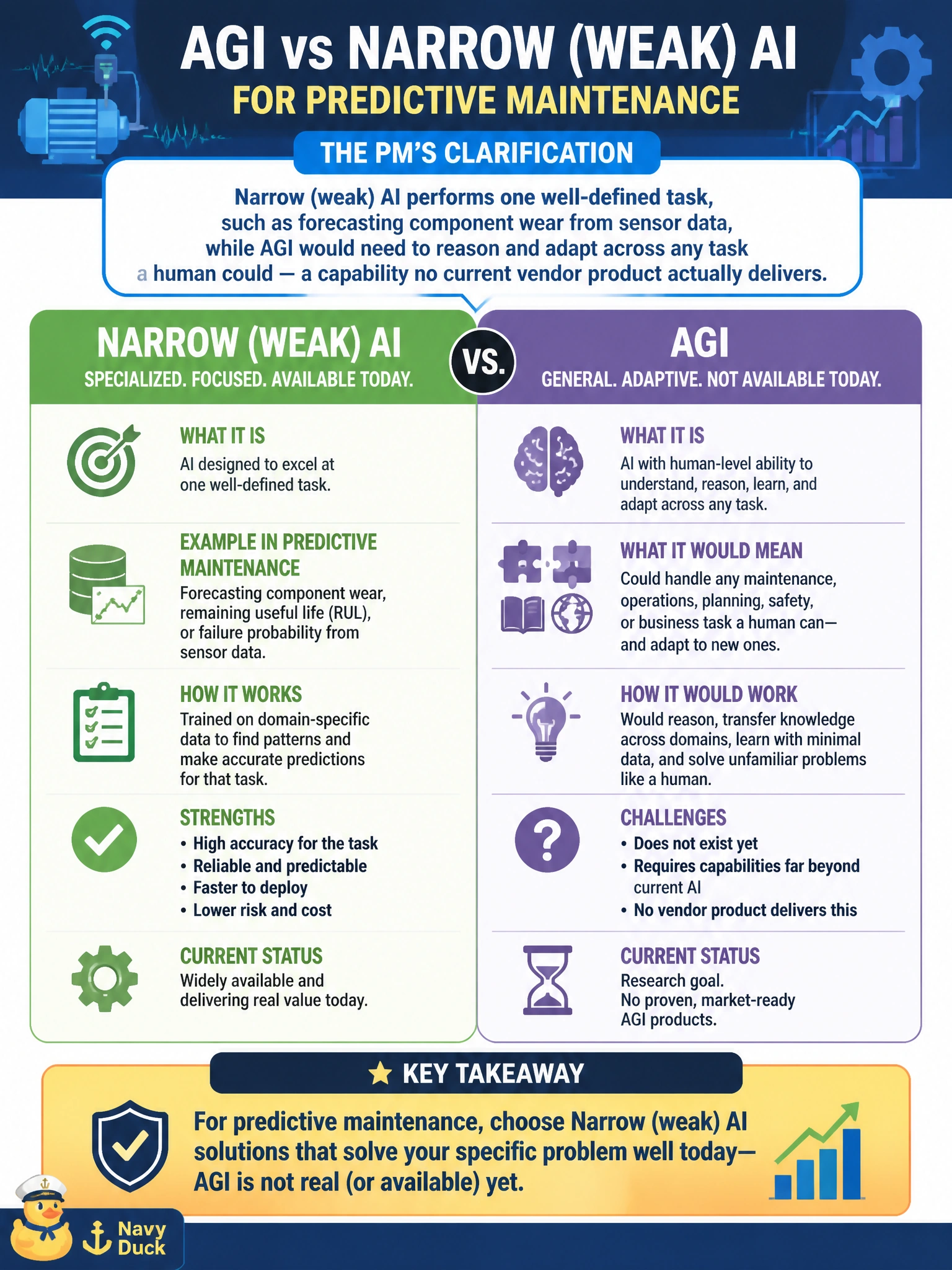
Short Explanation
Narrow AI is a specialist — great at one job, like reading vibration sensors, and lost outside it. AGI is the sci-fi generalist that can do anything a human can. No vendor is selling you real AGI in 2026, so if their pitch deck says it, read the fine print.
Full Explanation
CPMAI requires practitioners to separate AGI from Strong/Weak/Narrow AI precisely because vendors blur the line to inflate perceived capability. Narrow (weak) AI is scoped to a specific task — here, predicting component wear from sensor and maintenance-log patterns — and that scoping is exactly why it is buyable and deployable today. AGI describes a hypothetical system with human-breadth general reasoning across arbitrary tasks; nothing on the market, including any predictive-maintenance product, meets that bar. The 'marketing terms for the same technology' distractor is the dangerous one: it tells the PM there's no real distinction to interrogate, which is how overpromising gets past procurement. The 'on-premise vs. cloud' distractor confuses AGI/narrow AI (a capability-breadth distinction) with a deployment-location distinction, which is a completely separate CPMAI topic (Managing AI domain). The 'human supervision' distractor inverts the actual concern — narrow AI systems are commonly supervised for safety, while true general autonomy is the theoretical AGI risk, not a feature any current vendor offers. The practical takeaway for Meridian: budget and contract for narrow, task-scoped capability, and treat any AGI claim as a red flag.