
Meridian Regional Airlines' new VP of Digital asks the project team to define 'artificial intelligence' for a board slide before funding is approved. Which definition best matches how CPMAI frames AI relative to human intelligence?
Select an answer to reveal the explanation.
Short Explanation
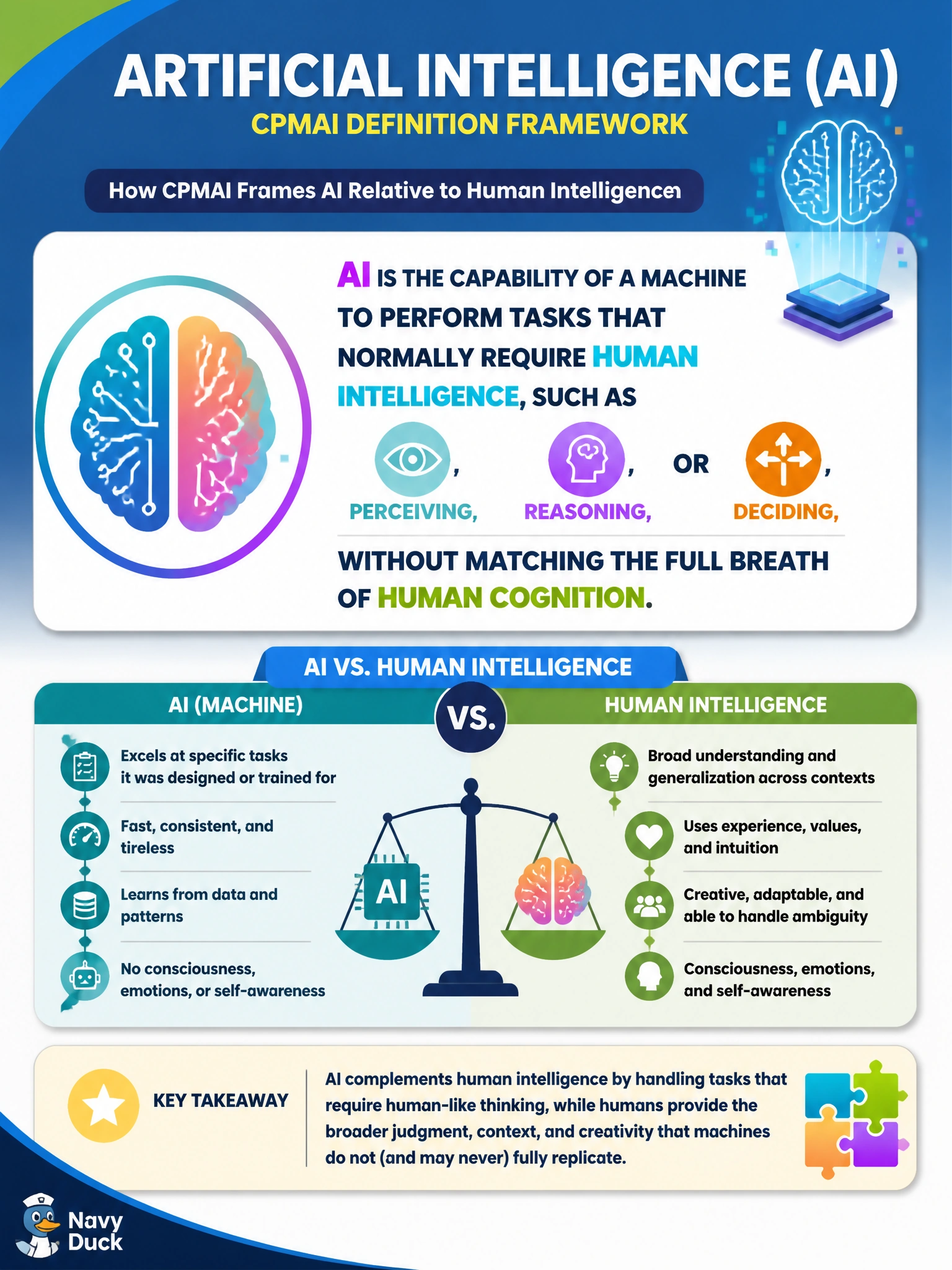
Think of AI as 'machine tasks that used to need a human brain' — narrower than a full human mind, but real intelligence-shaped work. Don't confuse it with plain automation (that's RPA) or with a machine that thinks exactly like a person (that's the AGI daydream).
Full Explanation
AI's working definition, for CPMAI purposes, is task-level: a machine performing perception, reasoning, or decision work that historically required a human, without claiming to replicate the whole of human intelligence. This matters at Meridian because the board needs to fund specific, scoped capabilities (predictive maintenance scoring, anomaly flags in loyalty data) rather than a vague promise of machine cognition. The 'automates a manual process regardless of learning' distractor collapses AI into RPA — a fixed, rule-following bot that does not learn is not what CPMAI means by AI, even though the two are often paired. The 'human-equivalent general reasoning across every domain' distractor describes AGI, a mostly theoretical and far broader concept CPMAI explicitly separates from ordinary applied AI. The 'rules engine configured once, never changing' distractor describes a static expert system or scripted automation, not a learning-capable AI system. Getting this right sets the tone for the whole business case: overselling AI as human-equivalent invites the overpromising CPMAI's methodology domain warns against.