
A company must deliver security awareness training to 5,000 employees who work remotely across several time zones. It needs self-paced content, automatic reminders, and completion records for auditors. Which delivery mechanism fits best?
Select an answer to reveal the explanation.
Short Explanation
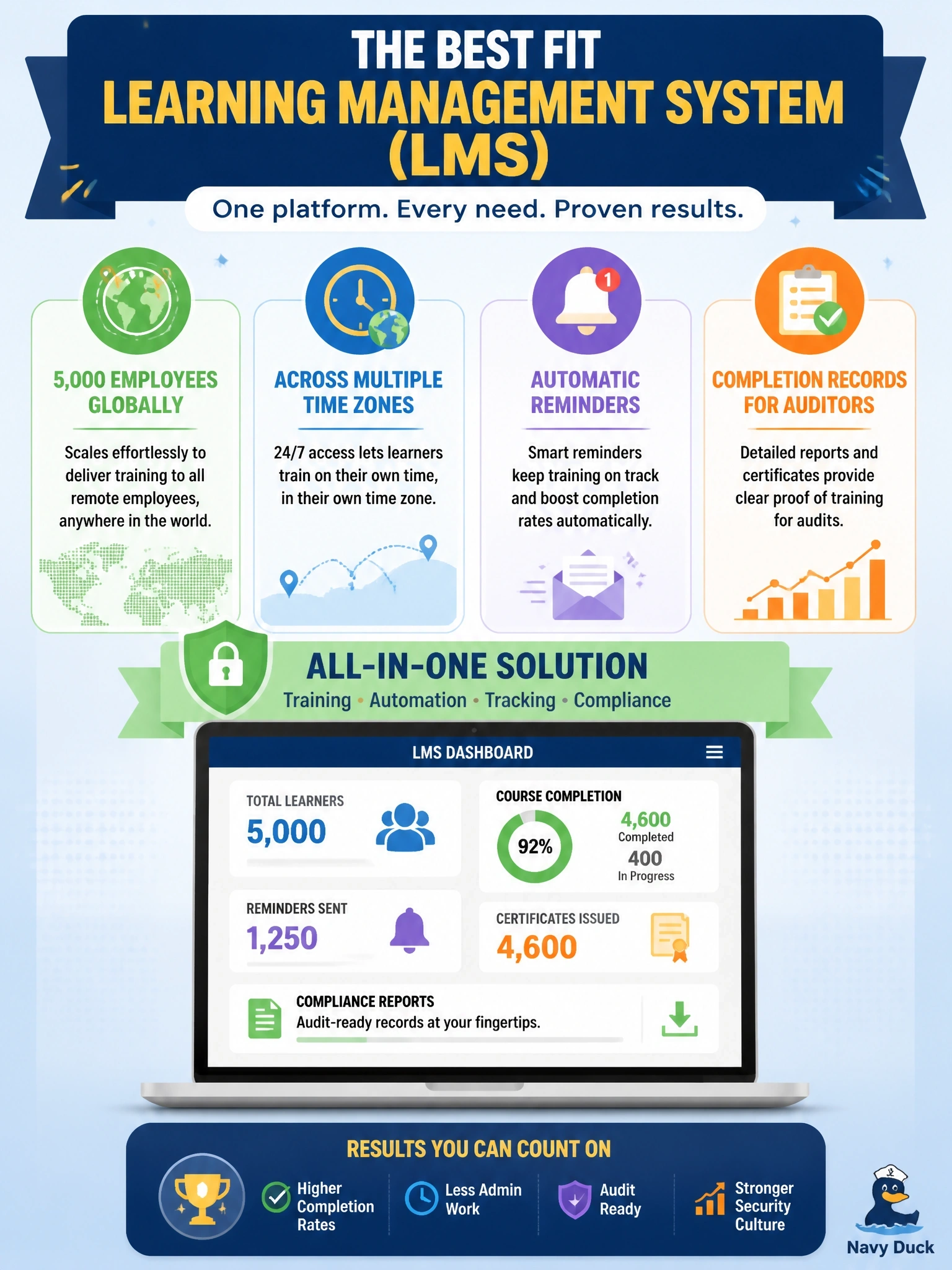
Five thousand people, many time zones, and an auditor asking for proof? That's an LMS job every time. It hands out the training, nags the stragglers and keeps the receipts. The trap is the live session, which can't reach everyone and leaves you with a sign-in sheet at best.
Full Explanation
A learning management system delivers, tracks, and reports on training at scale. It lets employees complete self-paced modules whenever suits their time zone, sends automatic reminders and escalations for overdue assignments, and records completion, scores, and timestamps that can be exported as evidence for auditors and regulators. For 5,000 remote employees with those requirements, an LMS meets every need. One-to-one coaching is highly effective for individuals who need personal attention, such as repeat phishing-simulation failures, but it does not scale to thousands of employees and produces no automated records. A live in-person classroom session is a one-to-many format but requires everyone to attend a physical location at one time, which fails for remote staff across time zones, and attendance tracking is manual. Posters in office break rooms are passive reminders that remote employees will never see, and they produce no evidence of completion or comprehension. Exam caveat: delivery mechanisms are often combined, with an LMS for baseline content and one-to-one or one-to-many sessions for targeted or corrective needs, so the best answer depends on the scale and evidence requirements in the scenario. Operational check: confirm the LMS assignment covers every active employee by comparing it with the HR roster and that completion reports can be exported for the audit period.