
Leadership asks whether the security awareness program is actually changing employee behavior. Which measurement provides the best evidence?
Select an answer to reveal the explanation.
Short Explanation
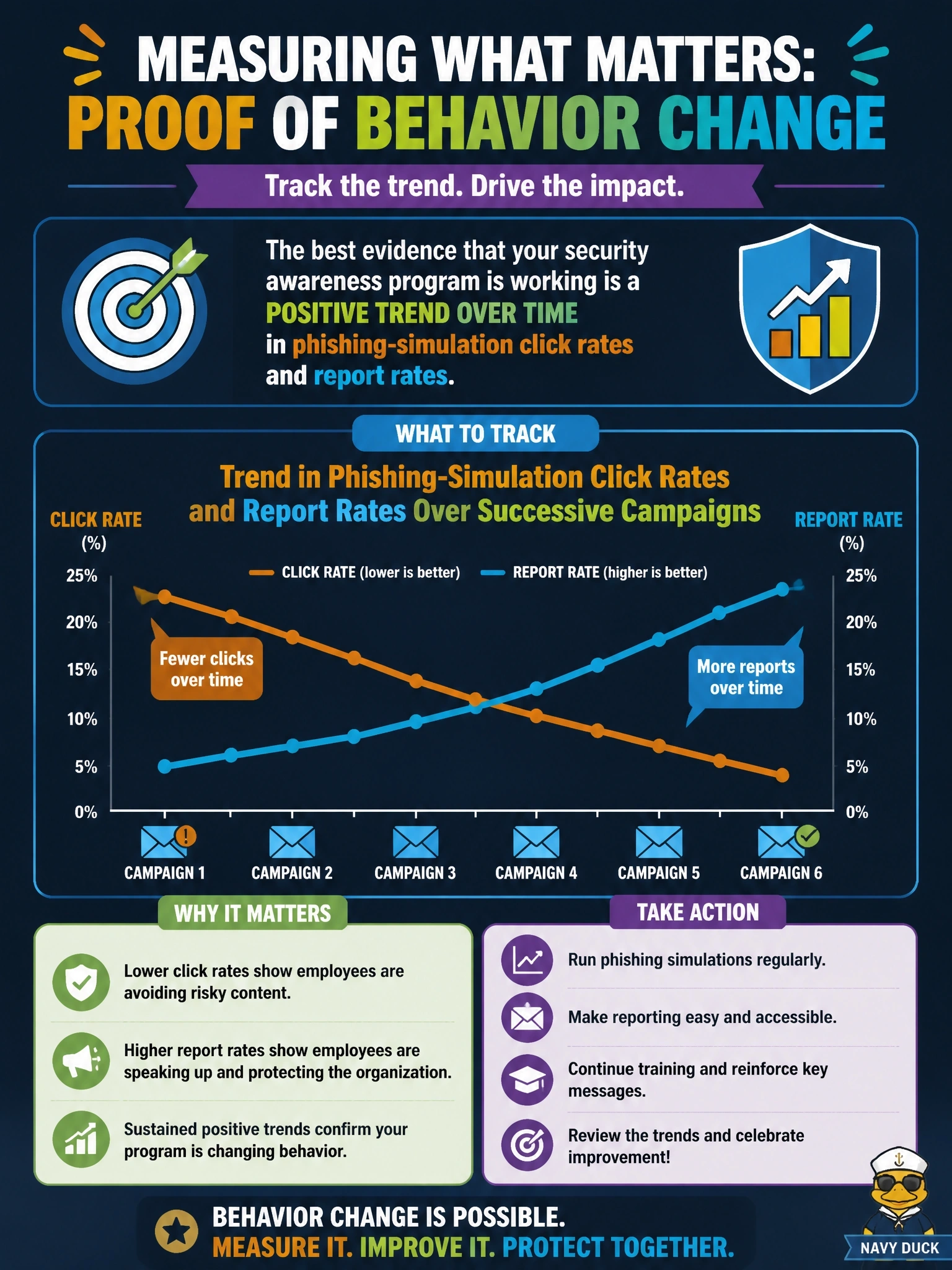
If you want to know whether people are behaving better, measure behavior: fewer clicks and more reports over time. Counting modules or posters tells you how busy the training team was, not whether anyone changed. That's the trap, activity versus outcome.
Full Explanation
Effective awareness reporting measures outcomes, meaning changes in what people do, rather than outputs such as how much content exists. Phishing simulations provide a repeatable behavioral measurement: the click rate shows how often employees fall for a lure, and the report rate shows how often they recognize it and notify security. Tracking both across successive campaigns of similar difficulty reveals whether behavior is improving, and the data can feed managerial reports and personnel behavior risk scoring. The number of modules published measures the training team's production; a large catalog says nothing about whether employees completed or applied it. Total hours of available video likewise describes supply, not consumption or behavior change, and more content can even reduce engagement. The count of posters and newsletters distributed measures communication effort, which may support awareness but provides no evidence that employees act differently. Exam caveat: simulation metrics are only comparable when campaign difficulty is controlled, so a sudden improvement may reflect an easier lure rather than better behavior, and report rate is often the more meaningful metric because it shows active defense. Operational check: chart click and report rates for each campaign with a difficulty rating, and present the trend alongside training completion so leadership can see the relationship.