
An employee has clicked the link in a phishing simulation for the second time this quarter. The security team wants to assign short, immediate training that addresses that specific mistake. Which type of training is most appropriate?
Select an answer to reveal the explanation.
Short Explanation
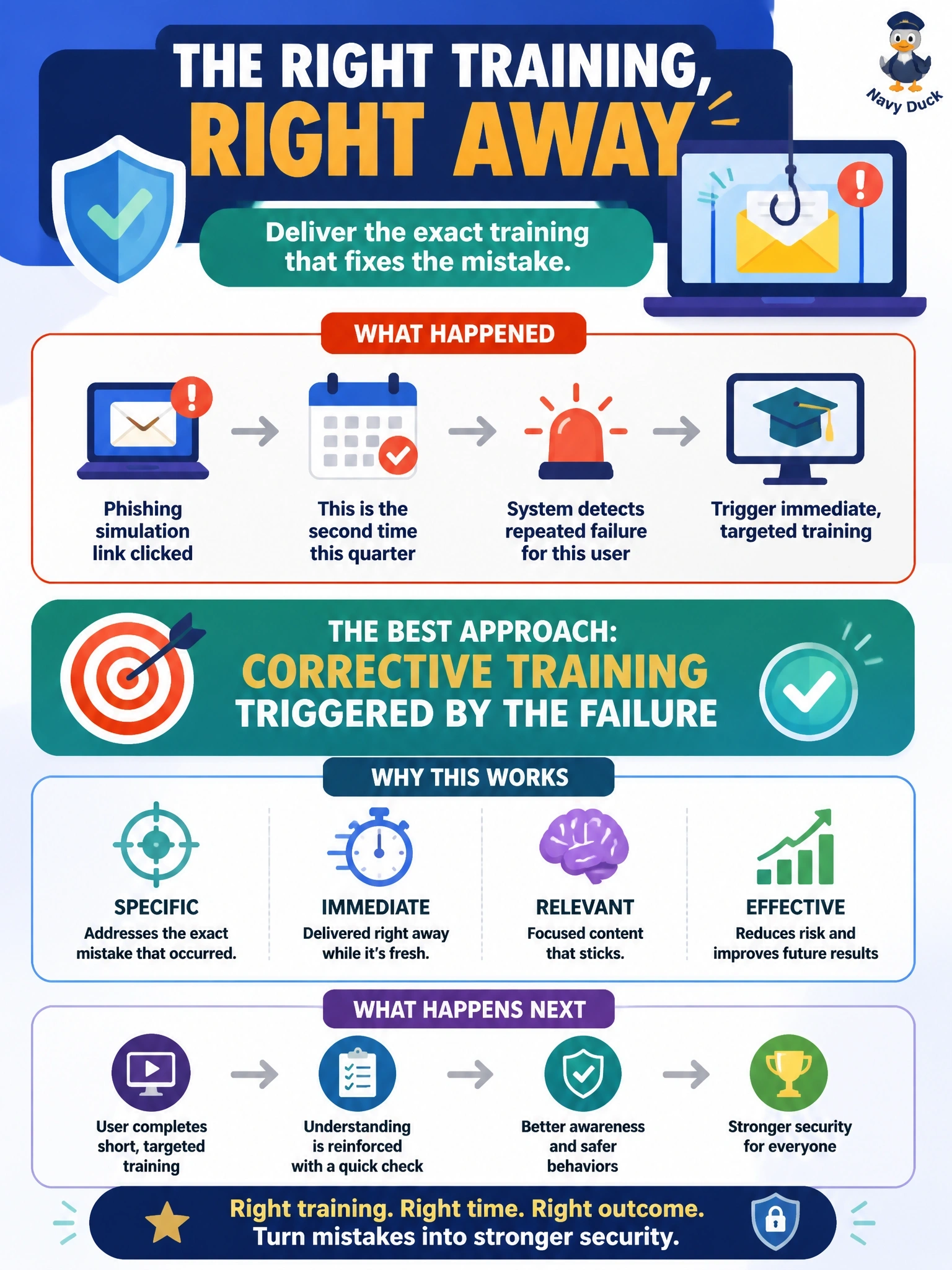
Corrective training is the instant replay after a fumble: right after the mistake, you walk through what went wrong and what to do next time. The timing and the specific failure are the clues. The trap is annual training, which is useful but won't land for months.
Full Explanation
Corrective training is delivered in response to a specific failure or policy violation, close to the event, and focuses on the behavior that went wrong. Assigning a short module immediately after an employee clicks a simulated phishing link, explaining the indicators missed and the correct reporting action, reinforces the lesson when it is most relevant. Repeated failures may also feed into personnel behavior risk scoring and escalate to closer coaching. Initial or onboarding training introduces new staff to policies and baseline security practices when they join; this employee is not new, and onboarding content is general rather than tied to the failure. Ongoing training, such as an annual program for all employees, maintains awareness over time; it is valuable, but scheduling the employee into the next annual cycle delays the response and dilutes the specific lesson. An executive tabletop exercise walks leadership through an incident scenario to test decisions and plans; it is not individual instruction for a staff member who failed a simulation. Exam caveat: targeted training, also listed in the objective, is tailored in advance to roles or groups with particular risk, such as finance staff and payment fraud, whereas corrective training is triggered by an observed failure. Operational check: confirm the simulation platform automatically assigns the corrective module and tracks completion and repeat failures.