
Help desk staff need step-by-step instructions to safely restart a payment service after hours, including the checks to perform before and after the restart and whom to notify. Which governance artifact should be created?
Select an answer to reveal the explanation.
Short Explanation
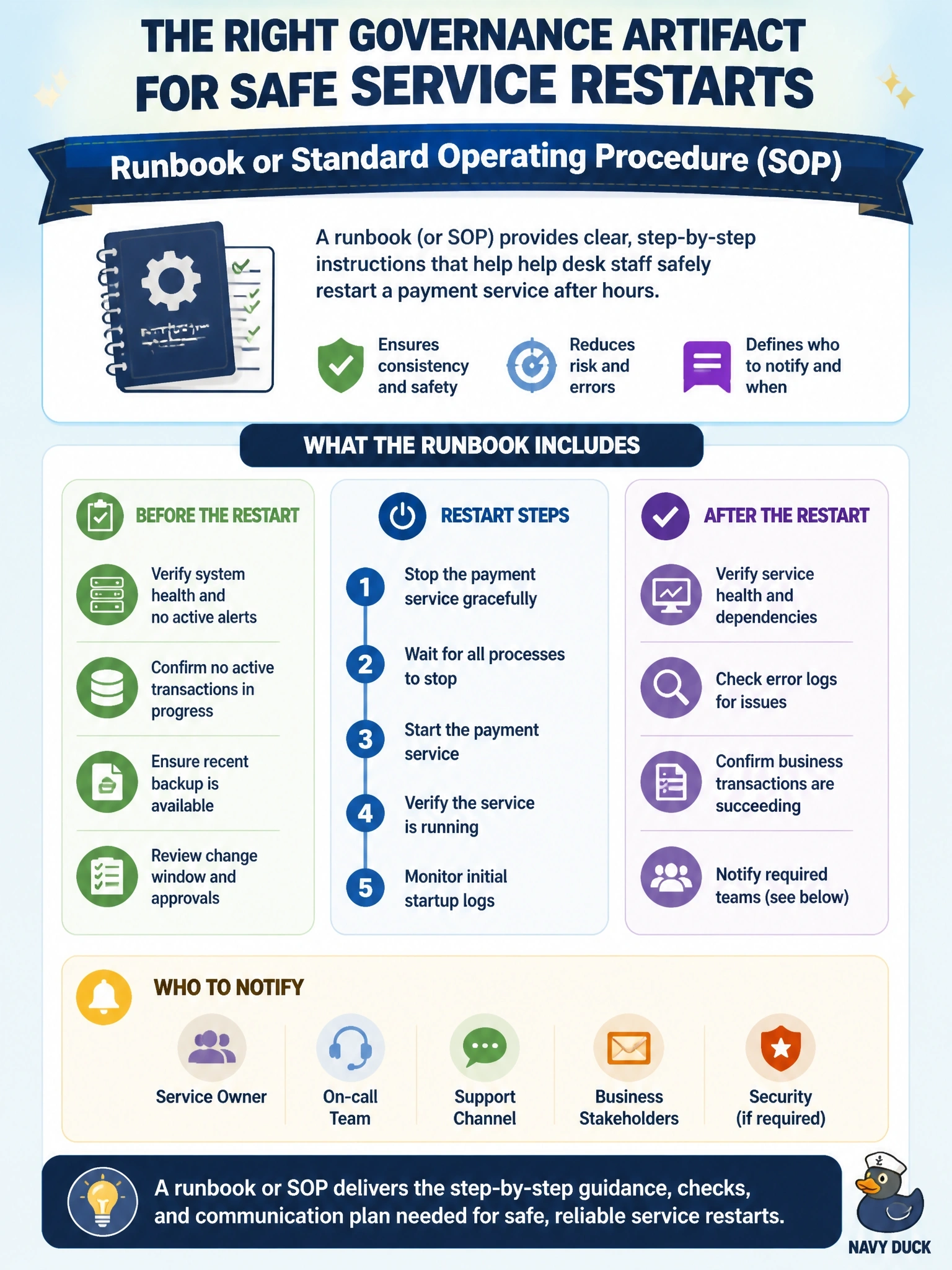
Think of a runbook like a recipe card taped inside the kitchen cabinet: exact steps, in order, so anyone on shift gets the same result. When the need is 'tell me exactly what to do', you want a procedure. The trap is the continuity plan, which is about keeping the business running, not about one restart.
Full Explanation
Procedures turn requirements into repeatable actions. A standard operating procedure documents the approved way to perform a routine task, and a runbook is the operational form of that, often detailed enough to automate: pre-checks, the restart steps themselves, post-checks, and escalation and notification contacts. For help desk staff restarting a payment service after hours, a runbook reduces errors, ensures consistent checks, and makes the work auditable. An information security policy is a high-level statement of management intent and responsibilities; it would never list the commands or checks for restarting a particular service. A business continuity plan addresses how the organization keeps critical functions operating during a significant disruption, such as staff relocation or manual workarounds; it is far broader than a single routine restart. A reference architecture is a guideline describing a recommended design pattern for a system; it shows how components should fit together, not how operators should act on a given night. Exam caveat: runbooks are also the building blocks of automation and orchestration, so a question about codifying a repeatable response often points to the same artifact. Operational check: have a second person execute the draft runbook in a test window, record any step that was unclear or missing, and update the document before it is approved for production use.