
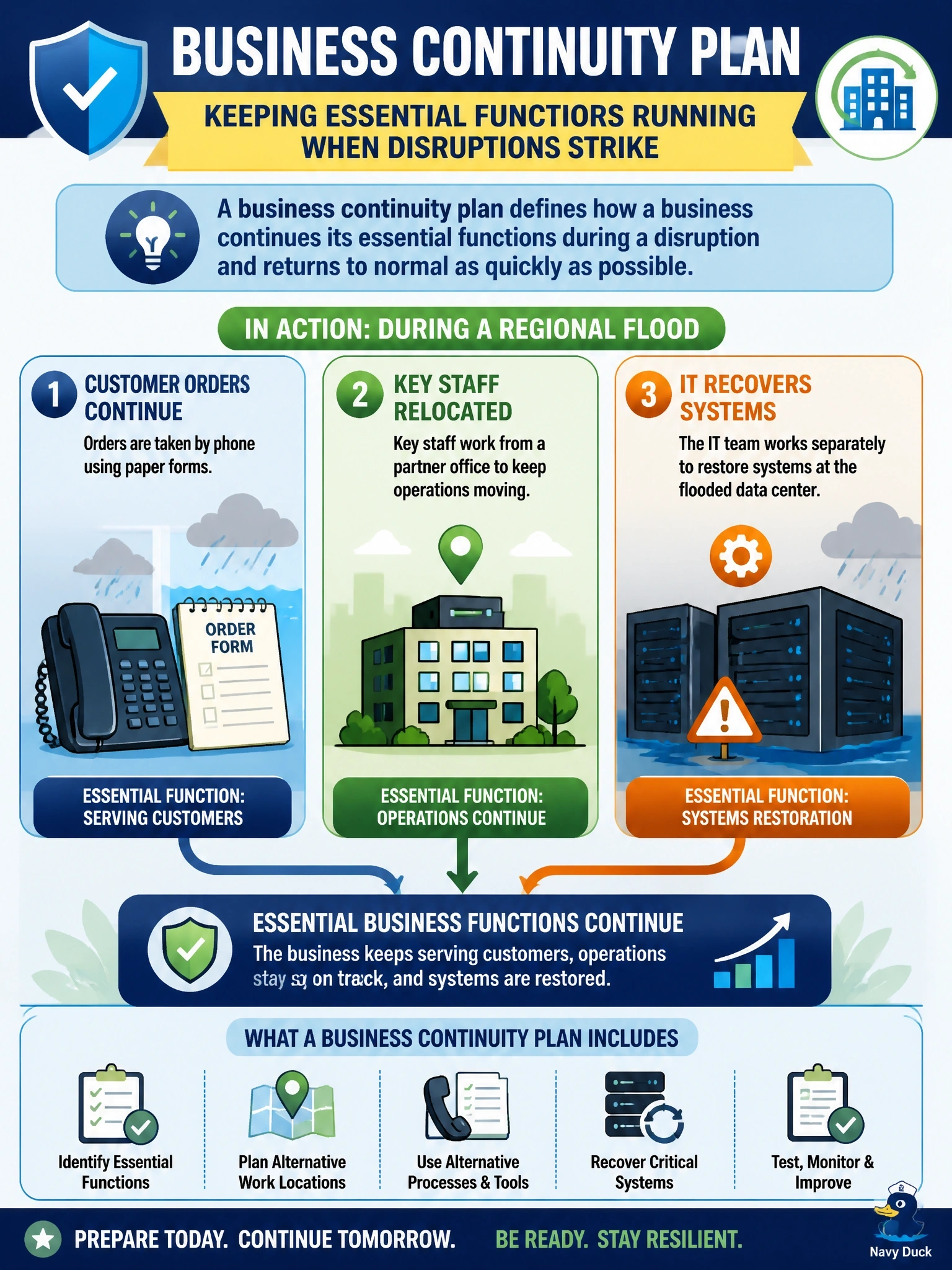
During a regional flood, a company keeps taking customer orders by phone with paper forms and relocates key staff to a partner office, while the IT team works separately to bring the flooded data center's systems back. Which plan governs keeping those essential business functions running?
Select an answer to reveal the explanation.
Short Explanation
Think of it this way: business continuity keeps the shop open, and disaster recovery fixes the building's wiring. You're taking orders on paper while IT rebuilds, and that's continuity in action. Don't let the flood pull you toward the DR plan just because a data center got wet.
Full Explanation
A business continuity plan defines how an organization keeps its essential functions operating during and after a disruption, including manual workarounds, alternate work locations, staffing and communications. Taking orders by phone on paper forms and relocating staff to a partner office are continuity measures: they sustain the business process itself while technology is unavailable. A disaster recovery plan is narrower and technology-focused, describing how systems, infrastructure and data are restored after a disaster; that is the work the IT team is doing in parallel, not the order-taking workaround the question asks about. An incident response plan governs detection, containment, eradication and recovery from security incidents such as malware or intrusions, and a natural flood that disrupts operations is not a security incident in that sense. A capacity plan forecasts the people, technology and infrastructure needed to meet future demand, which is a growth exercise rather than a response to disruption. Exam caveat: disaster recovery is commonly treated as a component that supports business continuity, so the two plans must align on recovery objectives and priorities. Operational check: confirm the continuity plan names the manual order process and the alternate site, that staff have practiced it, and that its timelines match the recovery objectives the disaster recovery plan commits to.