
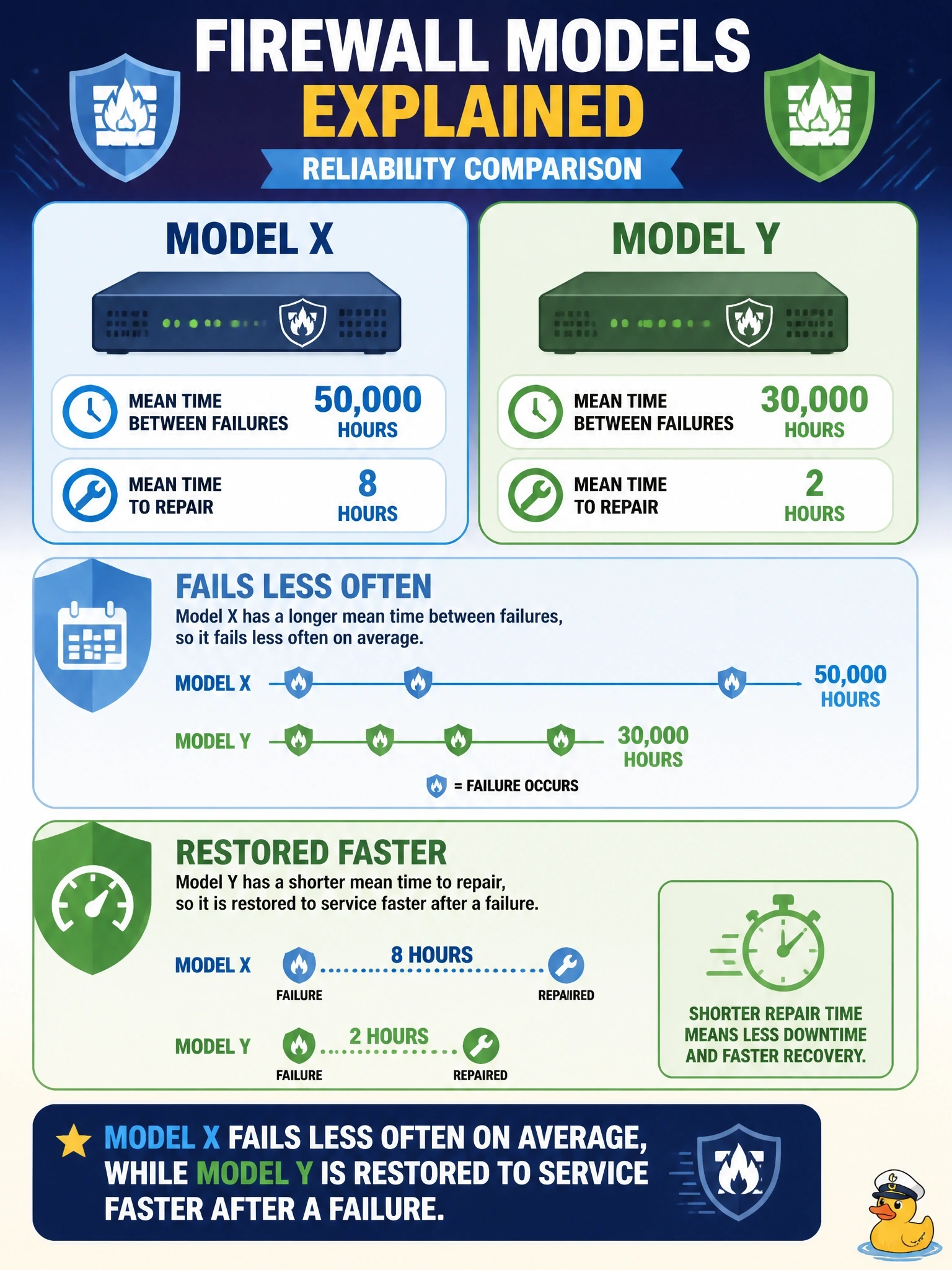
A team is comparing two firewall models. Model X has a mean time between failures of 50,000 hours and a mean time to repair of 8 hours. Model Y has a mean time between failures of 30,000 hours and a mean time to repair of 2 hours. Which statement is correct?
Select an answer to reveal the explanation.
Short Explanation
Two different questions: 'how often does it break?' and 'how fast can you fix it?' Bigger MTBF means it breaks less often, so that's Model X. Smaller MTTR means quicker repairs, so that's Model Y. Don't let one number answer the other's question.
Full Explanation
Mean time between failures measures reliability: the average operating time between failures of a repairable device, so a higher value means failures are less frequent. Mean time to repair measures maintainability: the average time needed to diagnose, fix and return a failed device to service, so a lower value means faster recovery. Model X, at 50,000 hours between failures, fails less often than Model Y at 30,000 hours, while Model Y, at 2 hours to repair, returns to service faster than Model X at 8 hours. Claiming Model X wins on both metrics misreads repair time, because its 8 hours is four times longer than Model Y's 2 hours. Claiming Model Y fails less often because of its lower repair time links two independent measurements; repair speed has no effect on how frequently a device breaks. Claiming Model X is restored faster because of its higher time between failures makes the same error in reverse, since reliability does not shorten the duration of any individual repair. Exam caveat: the two metrics are combined when estimating availability, and a frequently failing device that repairs quickly can still match a reliable one that repairs slowly, so the decision depends on the service's recovery time objective. Operational check: compare each model's repair time against the firewall service's recovery time objective, confirm spares or support contracts can meet it, and track actual failure and repair intervals after deployment.