
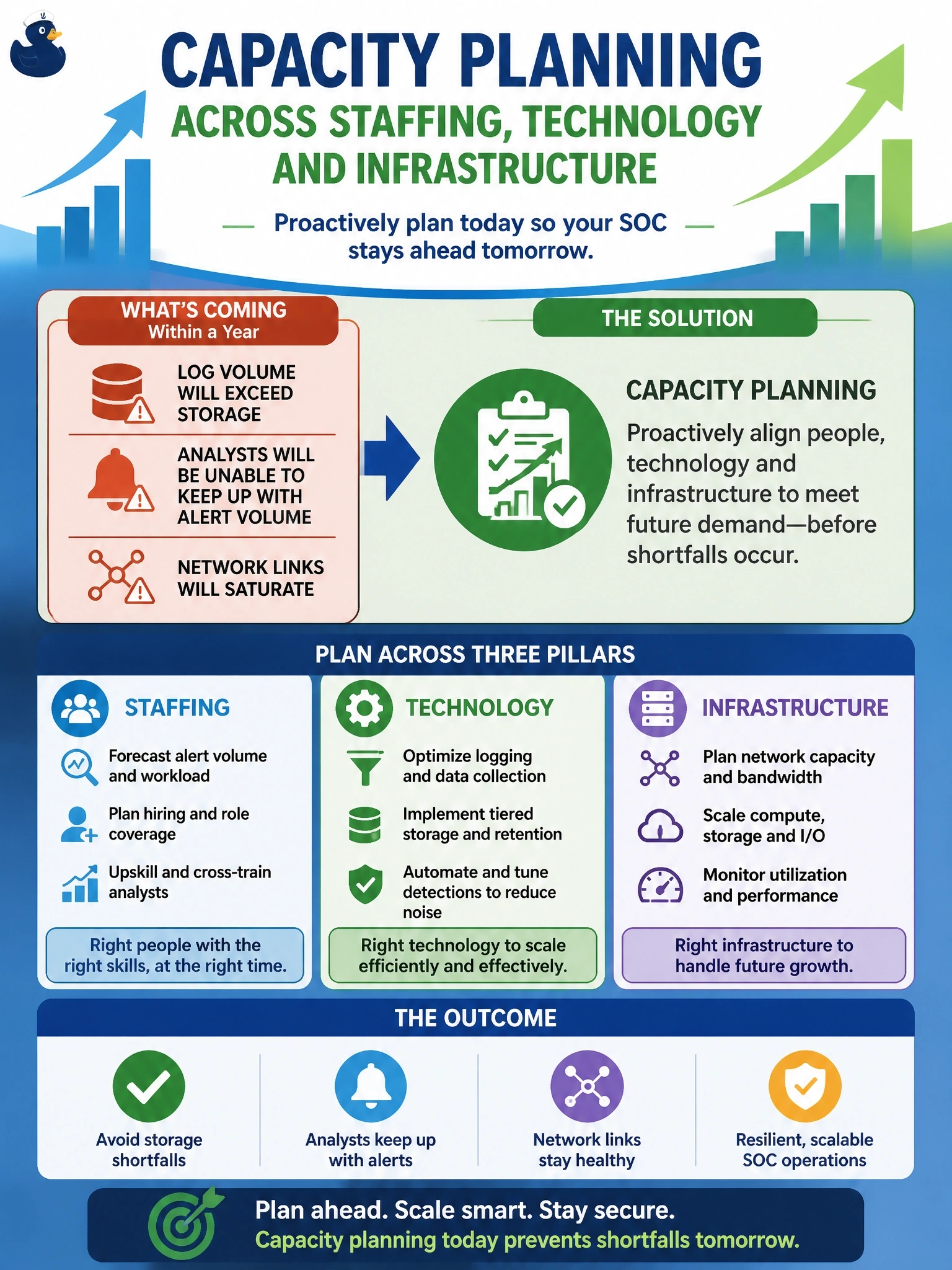
Growth projections show that within a year the security operations center's log volume will exceed its storage, its analysts will be unable to keep up with alert volume, and its network links will saturate. Which practice addresses these needs across people, technology and infrastructure before the shortfall arrives?
Select an answer to reveal the explanation.
Short Explanation
Capacity planning is like planning a growing family's move: you check you'll have enough rooms, enough car seats and a big enough driveway before the new kids arrive. You've got staff, storage and bandwidth all running short, so you need a plan that looks at all three. Autoscaling only fixes one of them.
Full Explanation
Capacity planning forecasts future demand and ensures that sufficient resources exist to meet it, and it explicitly spans people, technology and infrastructure. Projecting log growth, alert volume and bandwidth use, then budgeting for analysts, storage and network upgrades ahead of time, keeps the security operations center effective rather than discovering the shortfall when alerts start being dropped. A business impact analysis identifies critical processes and the consequences of their disruption to set recovery priorities and objectives; it does not project how resource demand will grow. Autoscaling adds compute automatically in response to load, which can help one technology dimension in a cloud environment, but it does not hire or train analysts, extend on-premises storage or widen network links. Load balancing distributes existing demand across existing servers, improving utilization and availability, yet it adds no capacity and does nothing for staffing. Exam caveat: capacity shortfalls are a security risk in their own right, because overwhelmed storage leads to lost logs and overwhelmed analysts lead to missed detections. Operational check: chart twelve months of log volume, alert counts per analyst and link utilization, project the growth curve, and confirm the budget and hiring plan close each gap before the projected exhaustion date.