
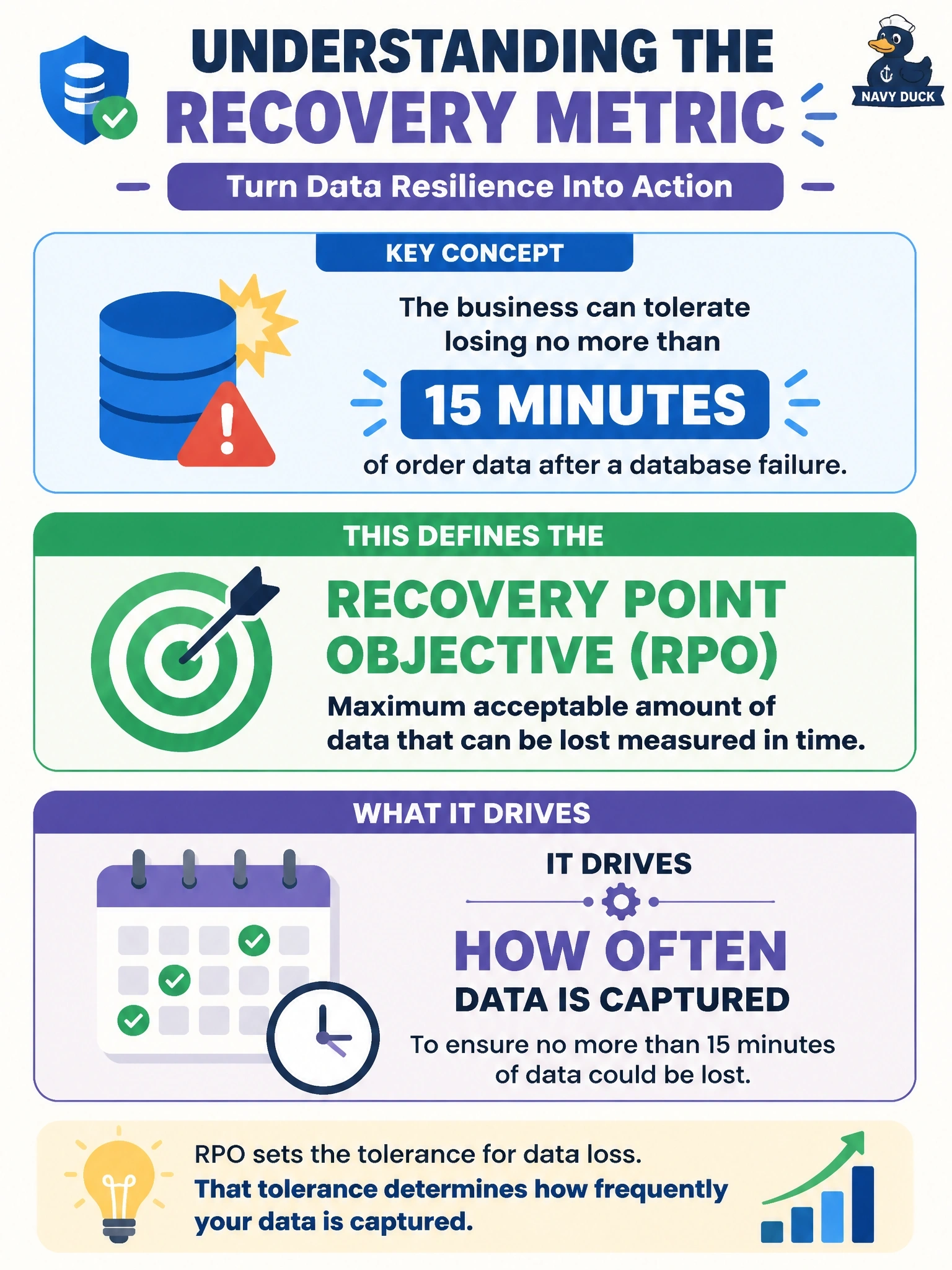
After any failure of its order database, the business states it can tolerate losing no more than 15 minutes of order data. Which recovery metric does this statement define, and what does that metric drive?
Select an answer to reveal the explanation.
Short Explanation
Point means a point in the past: how far back are you willing to rewind? Fifteen minutes of lost orders is a recovery point objective, so your backups or replication need to run at least that often. Recovery time's about how long you're down, which is a different clock.
Full Explanation
The recovery point objective is the maximum acceptable amount of data loss, measured as time between the last recoverable copy and the moment of failure. A statement that no more than 15 minutes of order data may be lost is a recovery point objective, and it drives how often data must be captured: backups, snapshots, log shipping or replication must occur at least every 15 minutes, and in practice more often to allow margin. The recovery time objective is the maximum acceptable duration of an outage before the service must be restored; attaching backup frequency to it confuses the two clocks, because a system can come back quickly and still lose an hour of data. Pairing the recovery time objective with how quickly the service must be restored describes that metric correctly, but the stem is about data loss, not downtime. Mean time to repair is an operational measure of how long it typically takes to fix a failed component, which informs maintenance and staffing, not the tolerance for lost data. Exam caveat: recovery point objective is about data looking backward from the failure, recovery time objective is about service looking forward. Operational check: confirm the replication or backup interval for the order database is 15 minutes or shorter, and verify in a restore test that the newest recoverable transaction falls within that window.