
A company wants to prove that its disaster recovery systems can actually process real transaction workloads correctly, but production must stay online and serving customers throughout the test. Which type of test best meets both requirements?
Select an answer to reveal the explanation.
Short Explanation
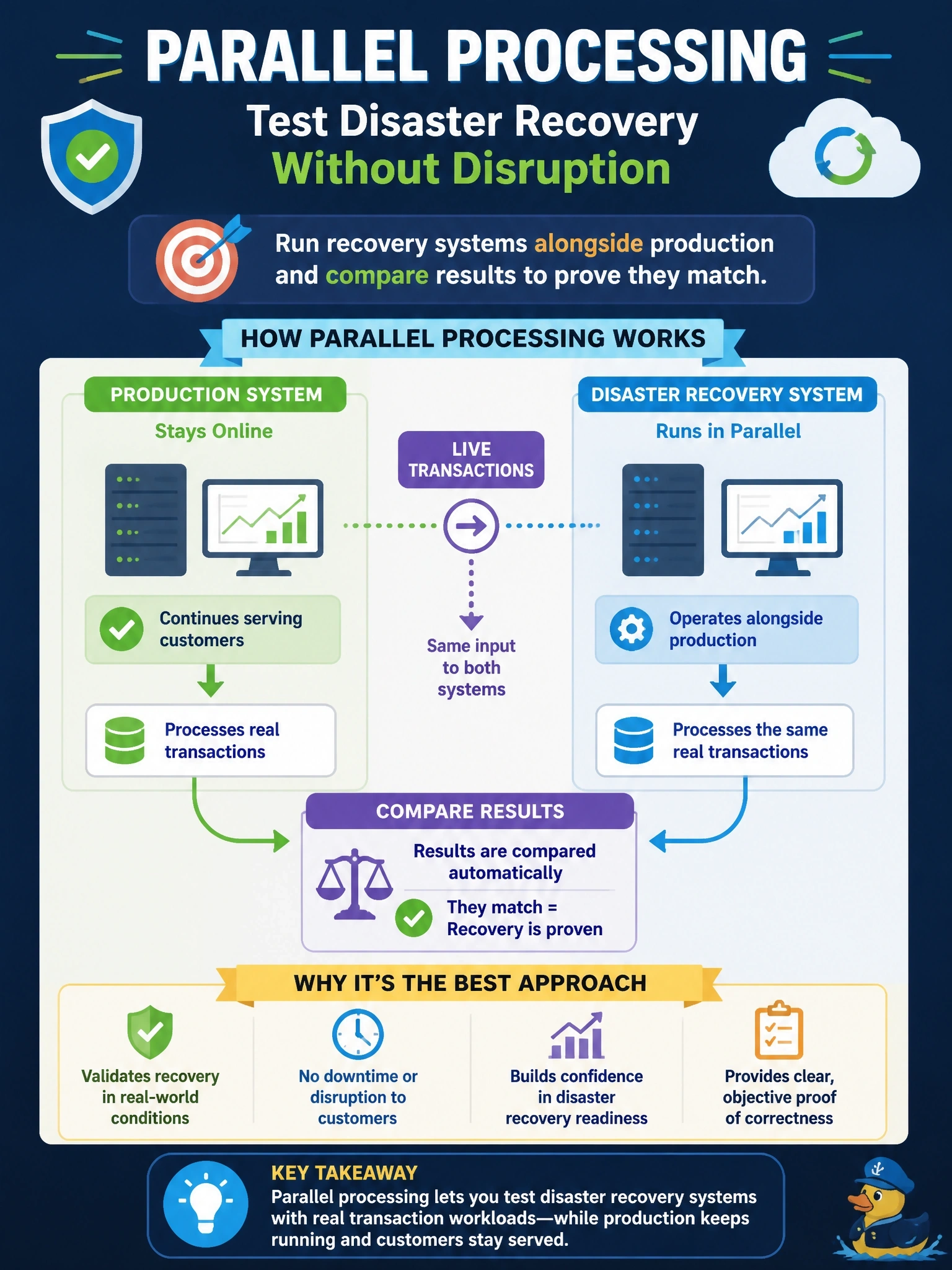
Think of it as a dress rehearsal with real props: the recovery site runs the same transactions side by side with production, and you compare the results. Production never goes dark. A failover would prove the point but takes production down, and a tabletop or simulation never touches real workloads.
Full Explanation
A parallel processing test runs the recovery systems at the same time as production, feeding them the same transactions so their outputs can be compared. It demonstrates that the recovery environment can genuinely handle real workloads and produce correct results, while production continues to serve customers without interruption. A failover test transfers the live load to the recovery site by taking production offline or redirecting traffic, which is the most realistic validation but directly conflicts with the requirement that production stay online. A tabletop exercise is a discussion-based walkthrough in which participants talk through roles and decisions; it is valuable for checking the plan and communication paths, but no system processes anything, so it cannot prove the recovery systems work. A simulation rehearses a disaster scenario with participants performing their steps, often in an isolated or mocked environment, yet as described here it does not process real transaction workloads, so it falls short of the proof the company wants. Exam caveat: disaster recovery testing escalates from discussion through simulation and parallel testing to full failover, trading realism against business disruption. Operational check: feed a defined batch of production transactions to both environments, reconcile outputs record by record, and document any discrepancies before signing off.