
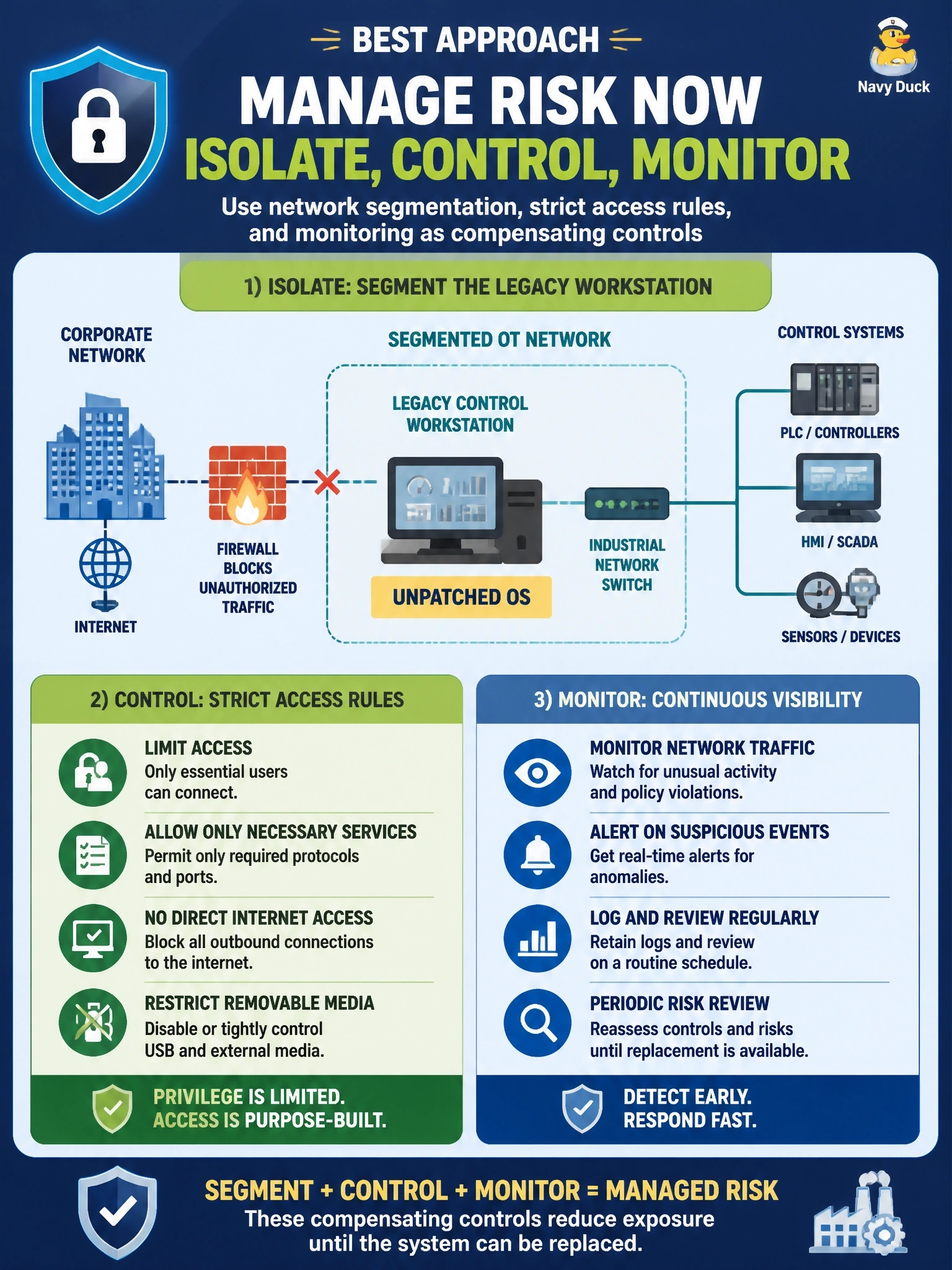
A manufacturing plant's control workstation runs an operating system that no longer receives vendor patches. The control software will not run on a newer release, and replacement is 18 months away. Which approach best manages the risk in the meantime?
Select an answer to reveal the explanation.
Short Explanation
An unsupported system is like a car that can't get recall repairs any more -- you can still drive it, but only on a short, safe route. You can't patch it, so you wall it off, limit who can reach it and watch it closely. The trap is thinking "no updates" means "nothing changes"; new flaws keep arriving, they just never get fixed.
Full Explanation
Unsupported and obsolete systems are vulnerabilities because new flaws discovered after end of support will never receive vendor fixes. When the system cannot be replaced immediately, often because critical software depends on it, the accepted approach is to reduce exposure with compensating controls: place the system in an isolated segment, allow only the specific connections it needs, restrict administrative access, disable unneeded services and monitor closely for anomalies. Leaving it on a flat corporate network maximizes its exposure to malware and lateral movement, and the absence of updates does not make a system stable against newly discovered attacks. Installing the newest operating system anyway would break the control software and halt production, trading a security risk for a guaranteed availability failure. Accepting the risk without documentation skips the governance step that records the decision, the compensating controls, the risk owner and the expiry date. Exam caveat: compensating controls reduce risk but do not eliminate it, so the replacement plan must stay on track. Operational check: verify the segment's firewall rules allow only required flows, confirm removable media and remote access are restricted, and record a time-limited exception in the risk register with an owner and review date.