
An assessment finds badge readers that accept unencrypted NFC credentials that can be cloned from a short distance, and IP cameras with Bluetooth maintenance pairing enabled and no PIN. Which threat vector categories does this assessment highlight?
Select an answer to reveal the explanation.
Short Explanation
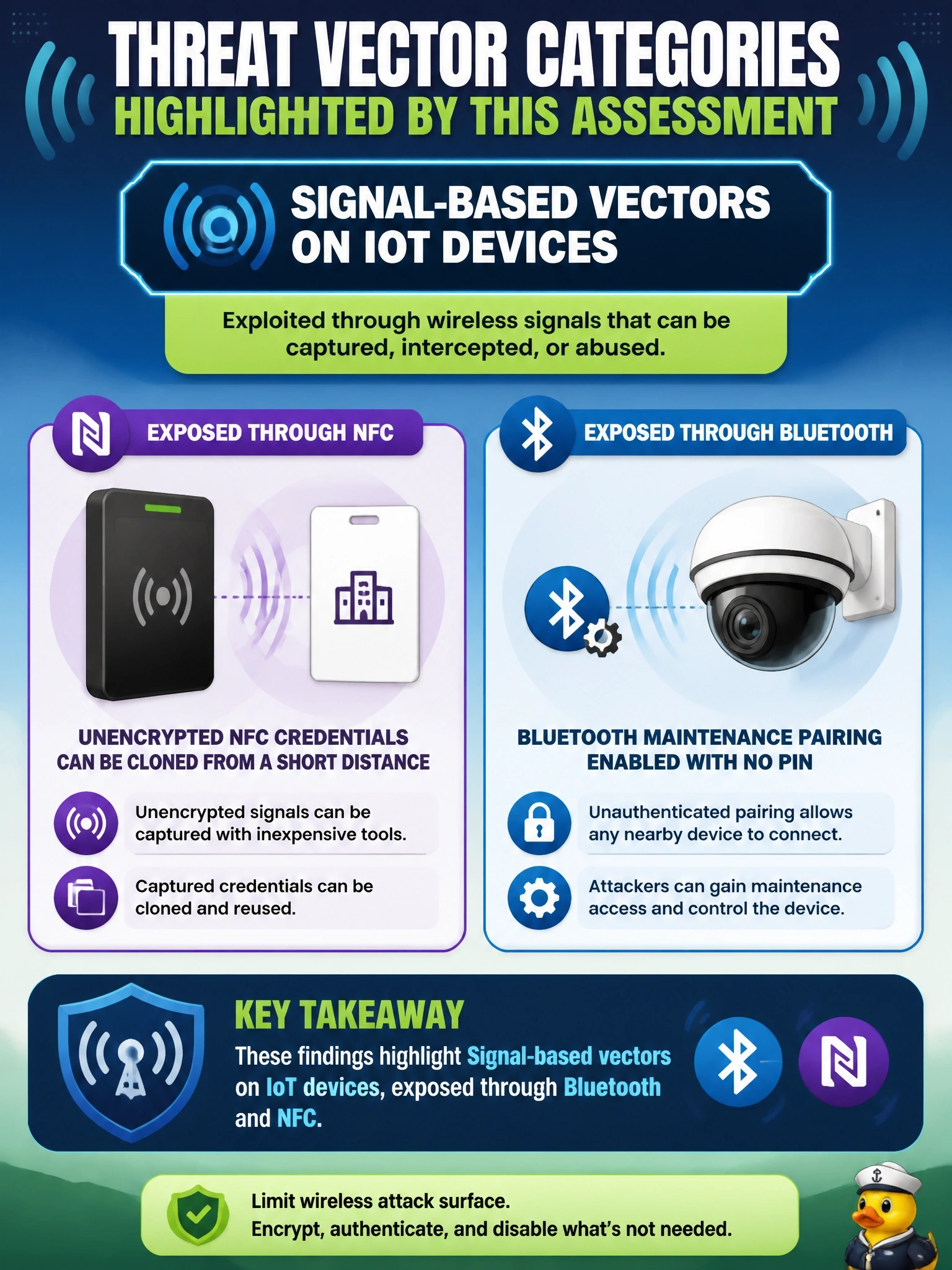
Your cameras and badge readers are computers too -- they just don't look like it. When they talk over Bluetooth or NFC without real protection, anybody standing close enough can listen in or pair up. That's IoT plus signal-based vectors, and you can't firewall your way out of a radio problem.
Full Explanation
Internet of Things vectors cover devices such as cameras, sensors and printers, which often ship with weak defaults and receive little monitoring. Signal-based vectors abuse wireless and low-power communications, including Bluetooth, radio frequency and near-field communications. Unencrypted NFC badges can be read and cloned by an attacker standing nearby, defeating physical access control, and cameras with open Bluetooth pairing let a nearby attacker connect to a maintenance interface without credentials. Both findings combine IoT devices with signal-based exposure. Message-based vectors on mobile phones involve SMS or RCS lures sent to people, and the findings concern device radios rather than messages. Remote access vectors such as VPN and VNC involve network services used to control systems over a network connection, not short-range radio interfaces on badge readers and cameras. Attachment-based vectors require a user to open a malicious file, and no files are involved in cloning badges or pairing with cameras. Exam caveat: short-range does not mean low risk, because attackers only need brief physical proximity, such as standing in a lobby. Operational check: replace badges with credentials that use cryptographic challenge-response, disable Bluetooth maintenance pairing or require a PIN, and add the devices to the asset inventory and patch schedule.