
A bank must move card data into its cloud provider without that traffic crossing the public internet, including inside a VPN. Which connection meets that constraint?
Select an answer to reveal the explanation.
Short Explanation
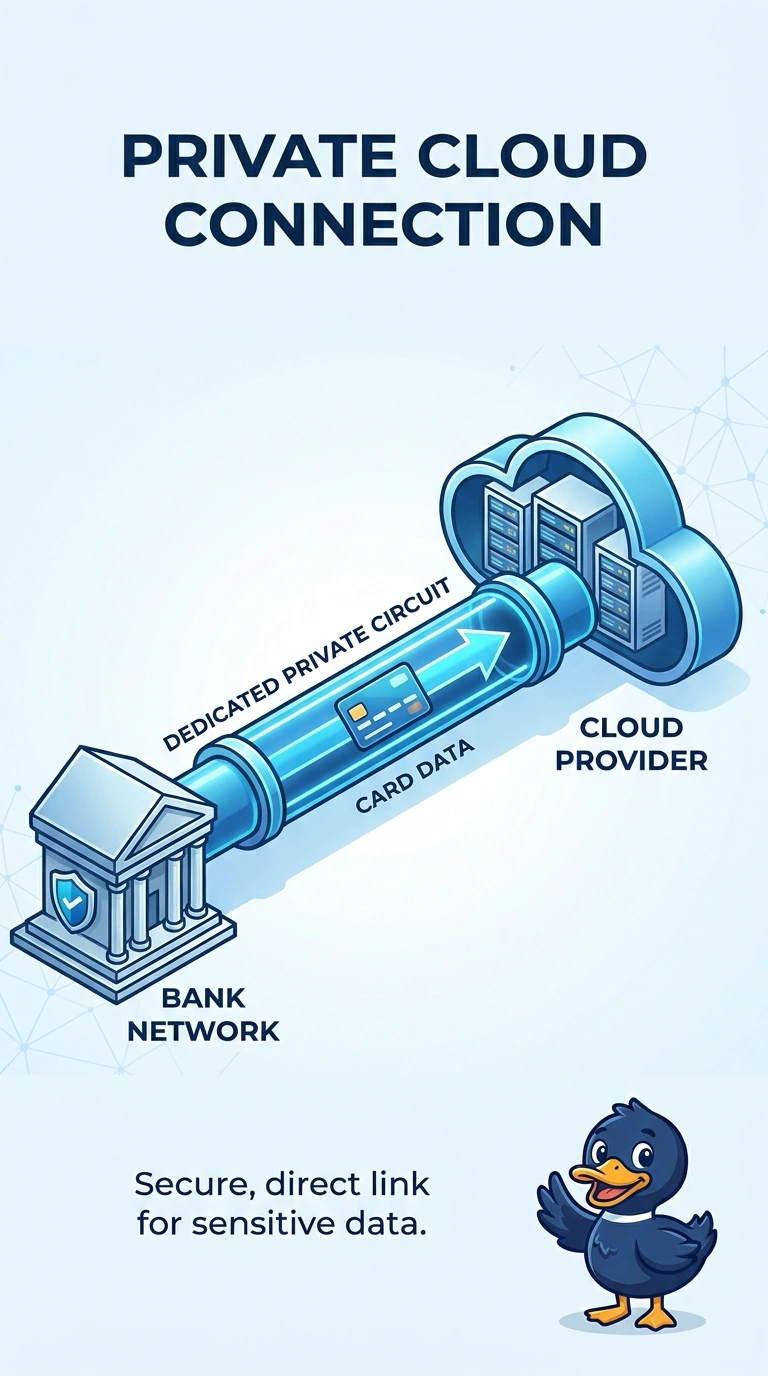
A locked truck on a public highway is still on the public highway, and a VPN over the internet still crosses the internet. You need a private road into the cloud, a dedicated circuit the provider hands off to the bank. A website login and a laptop split-tunnel setting do not build that road.
Full Explanation
A dedicated cloud connection, sometimes called a private interconnect, stays on a provider circuit instead of traversing the public internet. The bank forbids card data from crossing the internet even inside a VPN, so the dedicated circuit is the connection that meets the constraint. A site-to-site VPN encrypts traffic and still sends it across the public internet, which is the path the bank ruled out. A public website login is how a person reaches an application. It is not a private circuit for card data. Split tunneling chooses which of a laptop's flows enter a client VPN. It does not create a private circuit, and it is not the default path for this bank's card traffic. Exam caveat: the dedicated circuit still needs encryption and access control if the bank's policy requires them. Private does not mean uninspected. Operational check: confirm the virtual circuit lands in the bank's cloud network, trace a card flow, and verify it does not egress through an internet gateway. Trace one card flow after cutover and confirm the path stays on the private circuit.