
A workstation must reach every other host on its own subnet at once, the way an address-resolution request does. Which delivery method is that?
Select an answer to reveal the explanation.
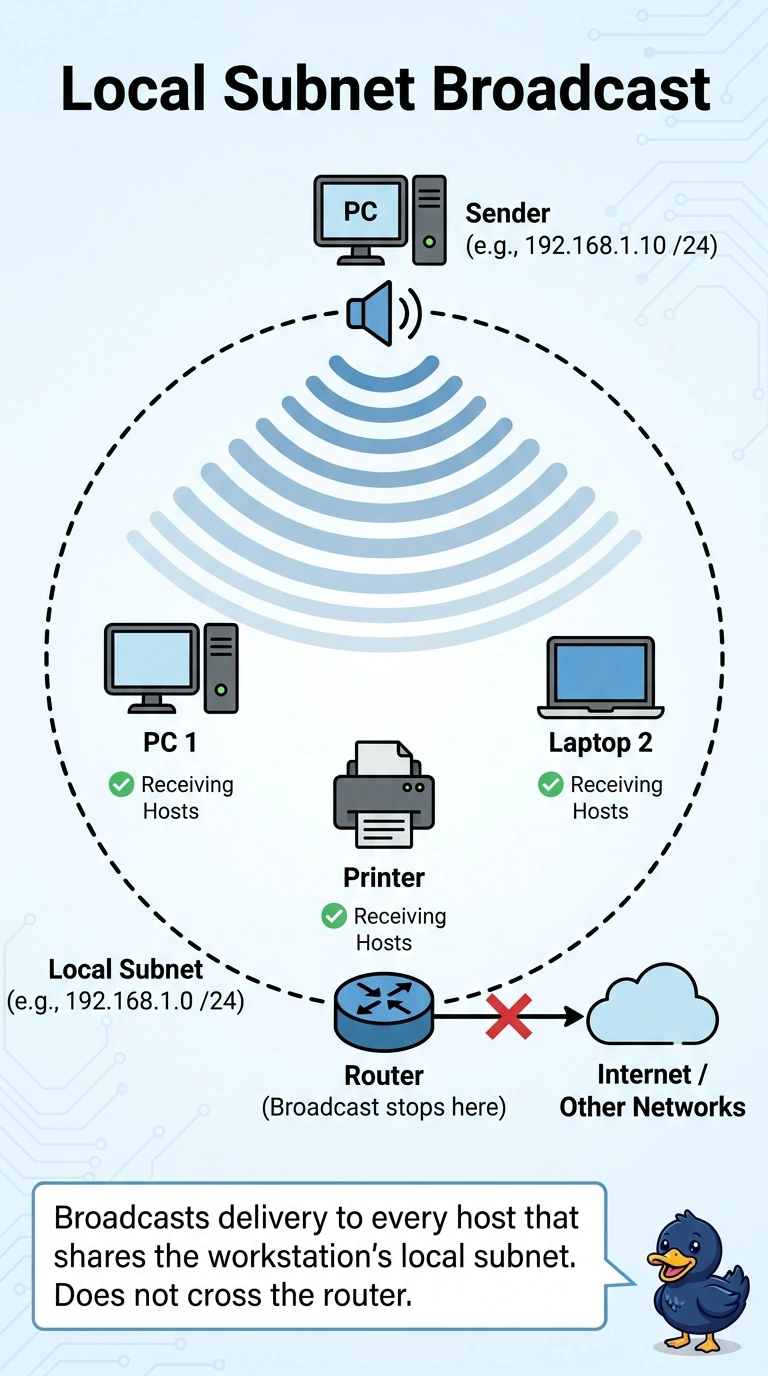
Short Explanation
You need to shout down the hallway so every door on this floor hears you, not invite a club, not walk into the nearest branch of a chain, and not whisper to one desk. That shout on the local subnet is a broadcast. Address resolution uses it because the sender does not yet know which single host owns the address.
Full Explanation
A broadcast is delivered to every host in the local broadcast domain. An address-resolution request is the classic case: the workstation does not know which MAC belongs to an IP address, so it asks every host on its own subnet. Multicast goes only to hosts that have joined a group. It does not reach every host regardless of membership. Anycast delivers a packet to the nearest of several copies of one address. It is not a one-to-everyone delivery on the local subnet. Unicast is addressed to a single destination. An address-resolution request cannot start as a unicast to one server when the sender does not yet know who should answer. Exam caveat: broadcasts stop at a router. They are not a way to reach every host in the whole campus. Operational check: capture on the subnet, find the request frame addressed to the broadcast MAC, and confirm it is not forwarded out to other subnets. Capture the request and confirm the router does not forward that broadcast to other subnets. If the request is leaving the subnet, a device is relaying it, and that relay is a different design from a local broadcast.