
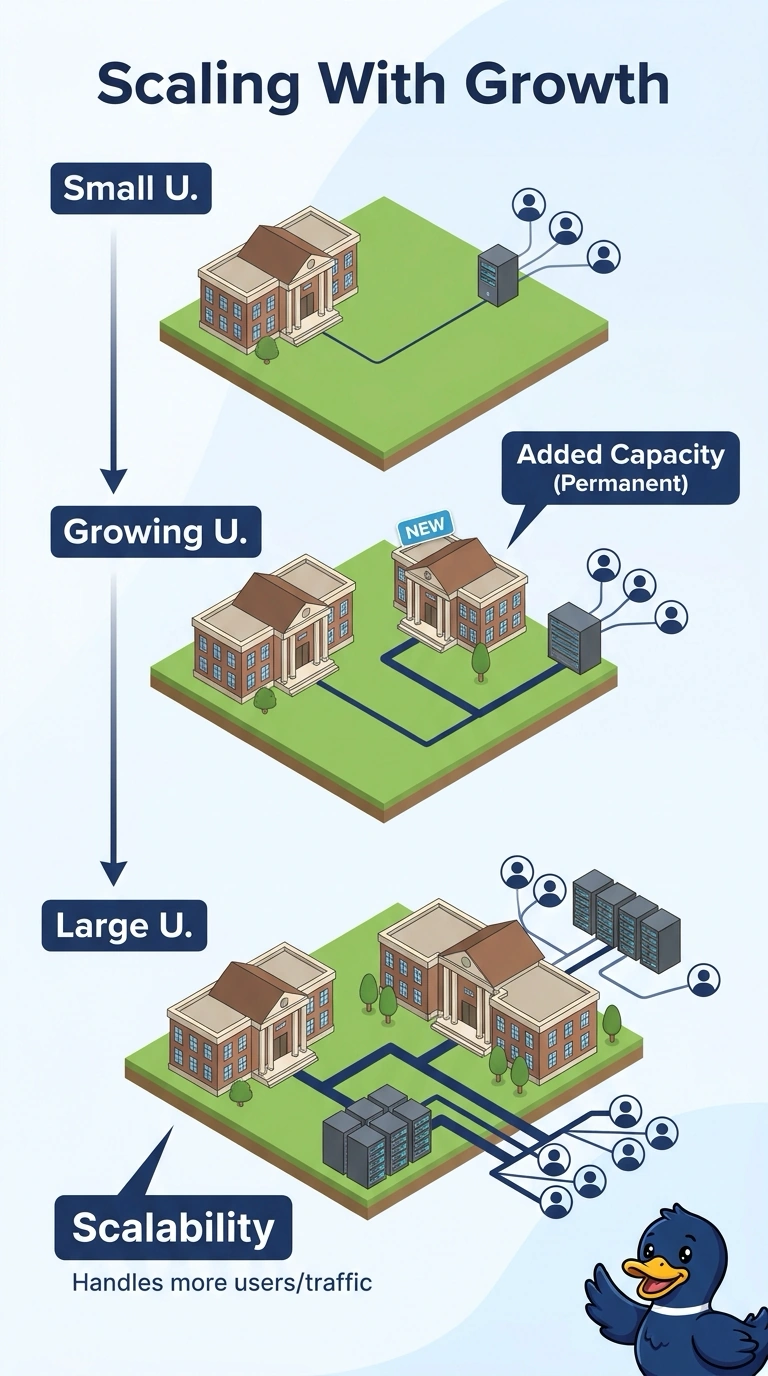
A university adds application capacity every year because enrollment keeps growing, and that capacity must stay in place. Which cloud property is this?
Select an answer to reveal the explanation.
Short Explanation
You are building another floor on the building because more students arrive every year, and you do not tear that floor down on Friday. That lasting growth is scalability. Elasticity is the weekend pop-up stand you pack away, and a shared building or an empty recovery site is not this growth plan.
Full Explanation
Scalability is the ability to add capacity to handle growth, and the added capacity stays. The university grows every year and must keep the extra application capacity, so the property is scalability. Elasticity adds capacity for a spike and releases it when the spike ends. Releasing the new capacity at the start of the semester is the opposite of what enrollment growth requires. Multitenancy means several customers share a provider's infrastructure with isolation between them. It is not the act of permanently enlarging one application. A cold site is space and power for disaster recovery. It does not add lasting application capacity. Exam caveat: a design can be both scalable and elastic. This stem asks about capacity that remains, which is the scalability half. Operational check: add the capacity, confirm it is still allocated after the peak week, and watch the utilization so the next year's growth has a date. Check a month later that the added capacity is still allocated. Do not release the added instances at the end of the week. That release would be elasticity, which this enrollment curve does not want.