
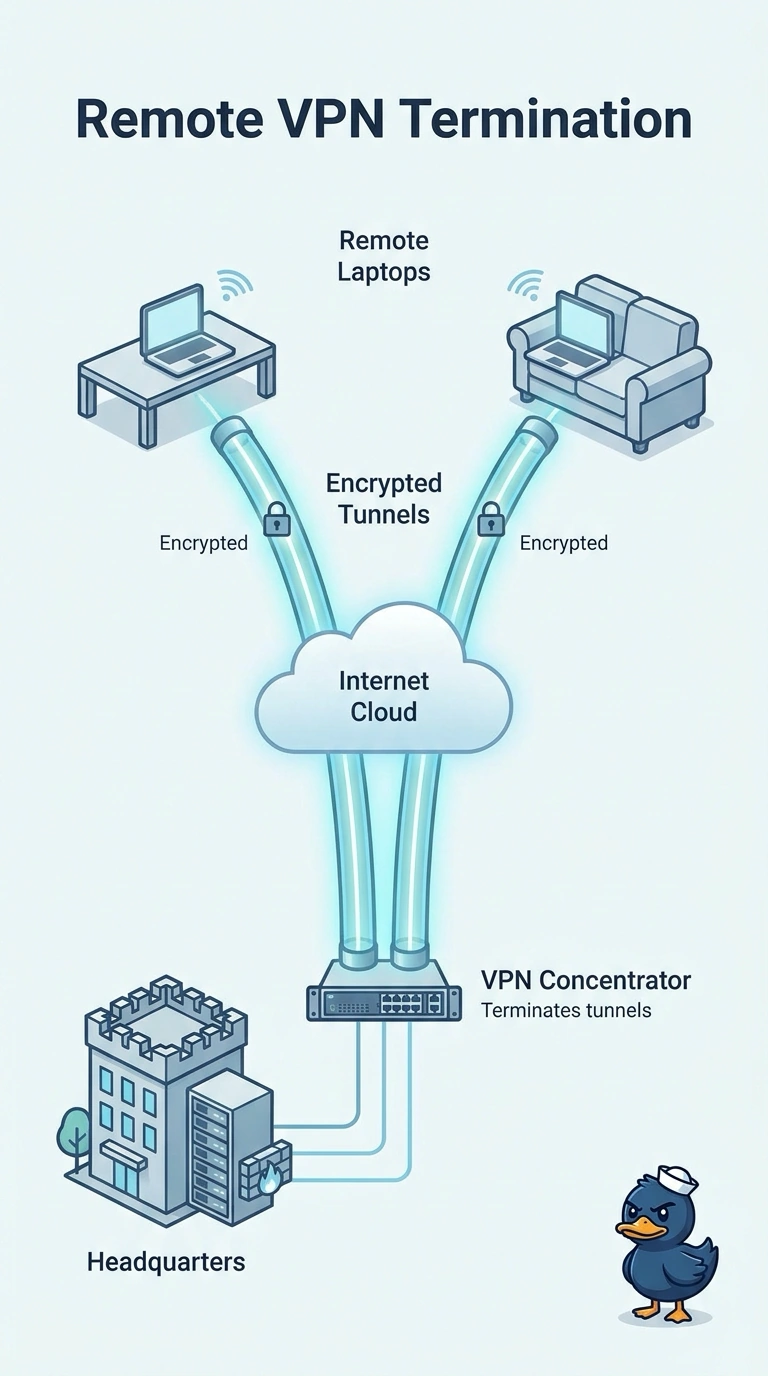
Many remote laptops at a law firm must terminate their encrypted tunnels on one device at headquarters. Which device is built for that job?
Select an answer to reveal the explanation.
Short Explanation
You need the device that ends many encrypted laptop tunnels at headquarters: a VPN concentrator. A storage-area network presents storage, an intrusion-detection sensor inspects traffic, and a cable certifier tests cabling; none does that tunnel-termination job. You still choose the tunnel type and authentication behind it.
Full Explanation
A VPN concentrator is a device, or a dedicated function, that terminates many remote-access VPN tunnels in one place. The law firm wants each laptop’s encrypted tunnel to end at headquarters, so a VPN concentrator performs the required job. A storage-area network presents block storage to servers; it does not terminate remote-access tunnels. An intrusion-detection sensor inspects a copy of traffic and alerts; it is not the endpoint of the laptop tunnels and does not decrypt them merely by sitting nearby. A cable certifier measures copper or fiber at installation time; it does not aggregate VPN sessions. Exam caveat: a firewall often includes the concentrator function, so focus on the function that terminates the remote tunnels rather than on a brand name. Operational check: confirm that the laptops land on the concentrator, authentication succeeds, and each session is torn down when the user disconnects. Also confirm that a laptop receives an address from the headquarters pool only after its tunnel is up, and that a disconnected laptop loses that path.