
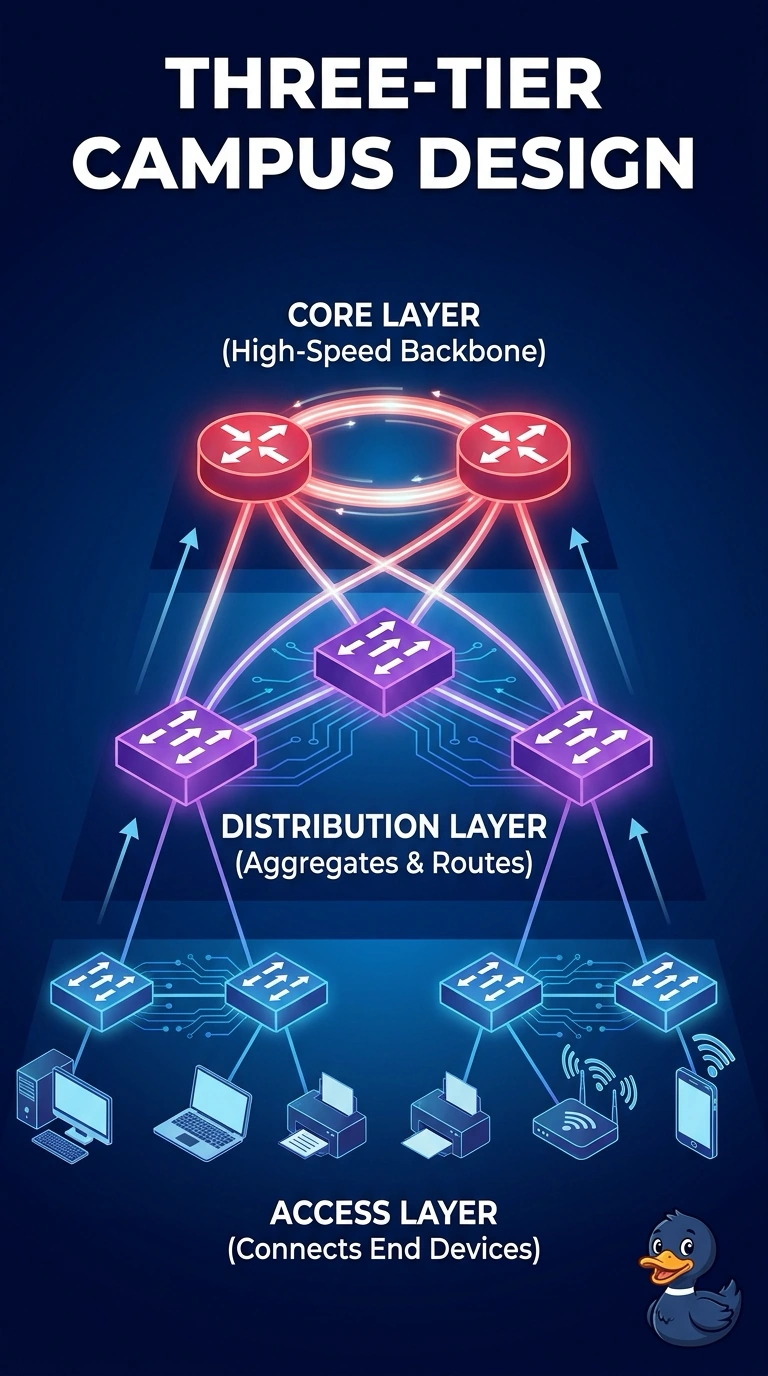
A large university has many buildings and wants separate access, distribution, and core layers so building switches do not all attach directly to the core. Which design is that?
Select an answer to reveal the explanation.
Short Explanation
A small shop can let the front counter and the back office be the same desk. A university with many buildings needs you to keep a real back office, a middle tier, and the counters, and that separation is the three-tier design. Collapsing the top two layers, meshing every closet switch, or skipping wires for a laptop-to-laptop network does not match.
Full Explanation
A three-tier campus separates the access layer, where users connect, the distribution layer, which aggregates buildings or floors, and the core, which forwards quickly between distribution blocks. The university has many buildings and does not want every building switch attached directly to the core, so three-tier matches. A collapsed core combines core and distribution into one layer. It fits a smaller site and does not keep a separate distribution layer. A full mesh of every access switch is expensive and is not the three-tier model. The three-tier model is hierarchical, not a link from every closet to every other closet. An ad hoc wireless network connects clients without an access point. It does not create core and distribution layers for a campus. Exam caveat: three-tier is a design choice for scale. A small building inside that campus can still use a collapsed closet. Operational check: draw the layers, confirm access switches uplink to distribution and distribution uplinks to the core, and confirm no access switch is homed only to the core.