
A ranger station has no fiber, no copper path, and no usable cellular signal back to the agency. Which medium can still carry the link?
Select an answer to reveal the explanation.
Short Explanation
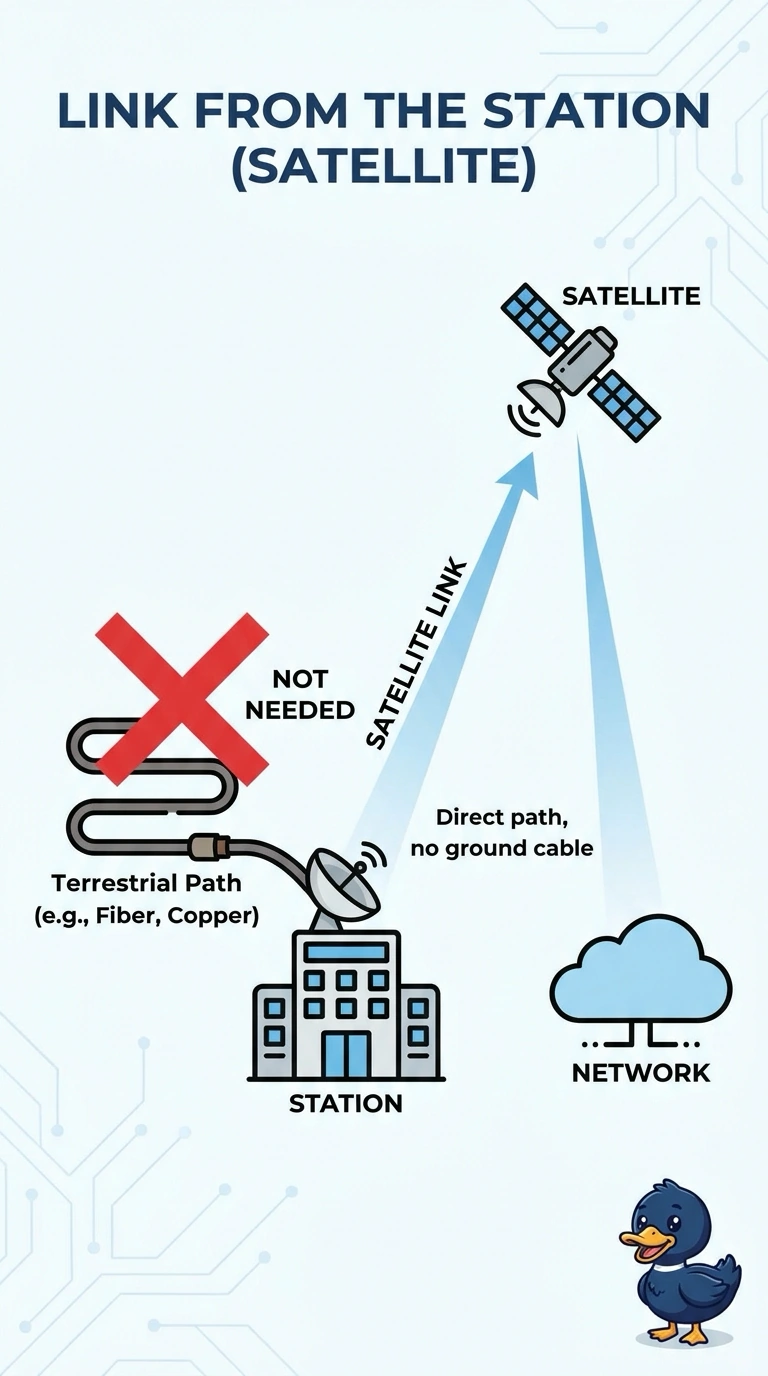
There is no wire in the ground and no cell tower you can use, so the path has to leave the earth and come back down. That path is satellite. A fiber that was never pulled, a lobby-grade radio aimed at a station tens of kilometers away, and a rack cord stretched across the county are not links you can light.
Full Explanation
Satellite provides a wide-area path where no fiber, copper, or usable cellular signal exists. The ranger station has none of those terrestrial options, so a satellite link is the medium that can still carry traffic. Multimode fiber needs fiber in the path. The stem says there is no fiber. A 2.4 GHz access point is a local wireless coverage radio. It does not bridge tens of kilometers back to an agency as if it were a wide-area circuit. Direct-attach twinax is a short copper assembly for inside a rack or between adjacent racks. It cannot run from an agency to a remote station. Exam caveat: satellite latency is high because of the distance the signal travels, so voice and interactive apps will feel the delay even when the link is up. Operational check: confirm the terminal has a clear view of the satellite, test throughput and latency, and set expectations for applications that cannot tolerate that delay. Ask the agency which applications must tolerate the extra delay, and do not promise interactive voice the same performance as a fiber circuit.