
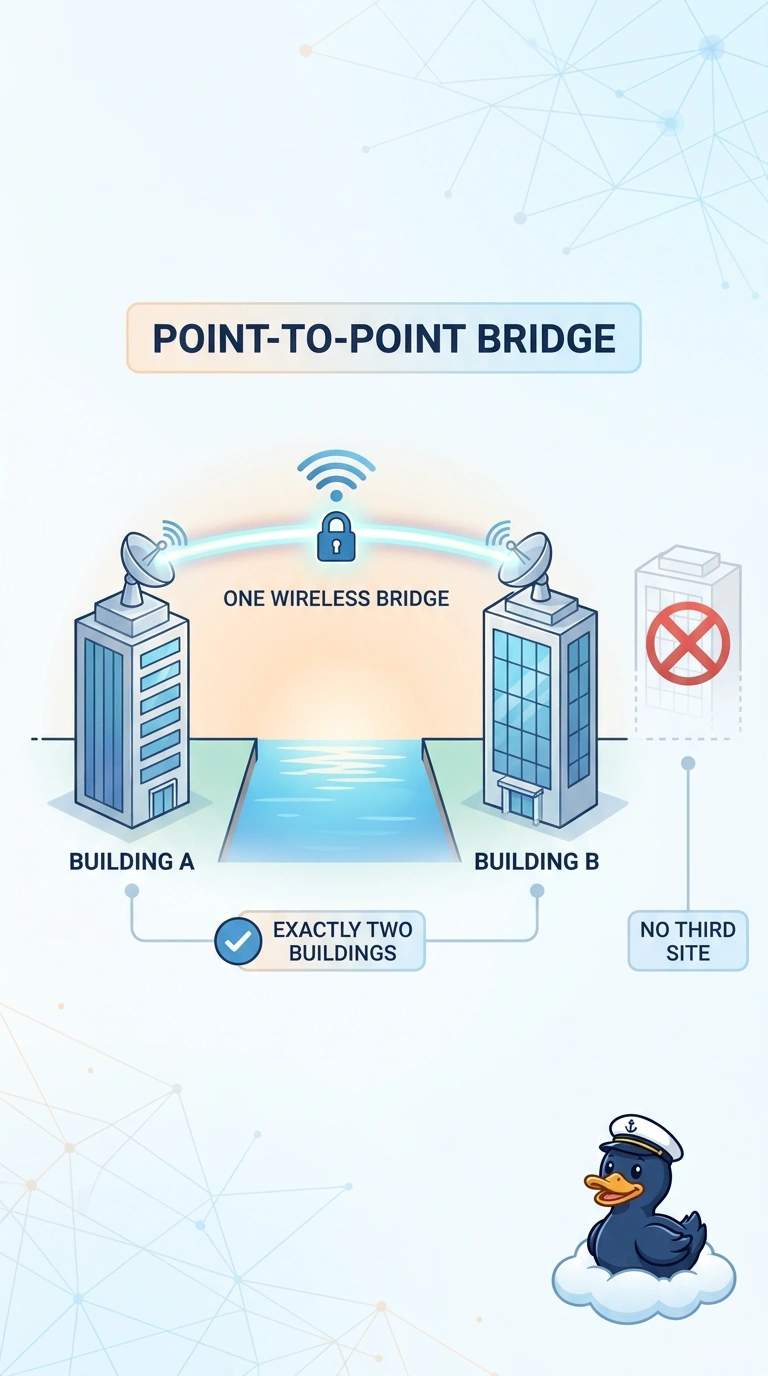
A community college links two buildings with one dedicated wireless bridge and has no third site on that link. Which topology is the bridge?
Select an answer to reveal the explanation.
Short Explanation
Two buildings and one bridge is a single rope between two trees, not a web of ropes. You call that link point-to-point because it has exactly two ends and no third site. A full mesh, a hub with spokes, or a partial mesh all need a bigger drawing than the one link on the roof.
Full Explanation
Point-to-point is a link with exactly two endpoints. The college has two buildings, one dedicated wireless bridge, and no third site. A full mesh connects every site to every other site. With only two buildings there is nothing else to interconnect, and the name for this single bridge is point-to-point. Hub-and-spoke places several spokes on one hub. This bridge has two ends and no hub serving other sites. A partial mesh is the tempting twin because it also uses direct links. It still needs more than one link among more than two sites, which this roof does not have. Exam caveat: a third building later, with its own bridge back to only one of these two, would change the picture. The name follows the links that exist today. Operational check: confirm the radios are aimed only at each other, that no third remote is configured, and that a failure of this one link isolates the two buildings. Record the reading before the change and the reading after it so the next shift can see the symptom actually moved.