
Payroll files at a county office still move with clear-text FTP on TCP 21. The transfer should change to the encrypted file service that uses the Secure Shell port. Which service and port replace FTP?
Select an answer to reveal the explanation.
Short Explanation
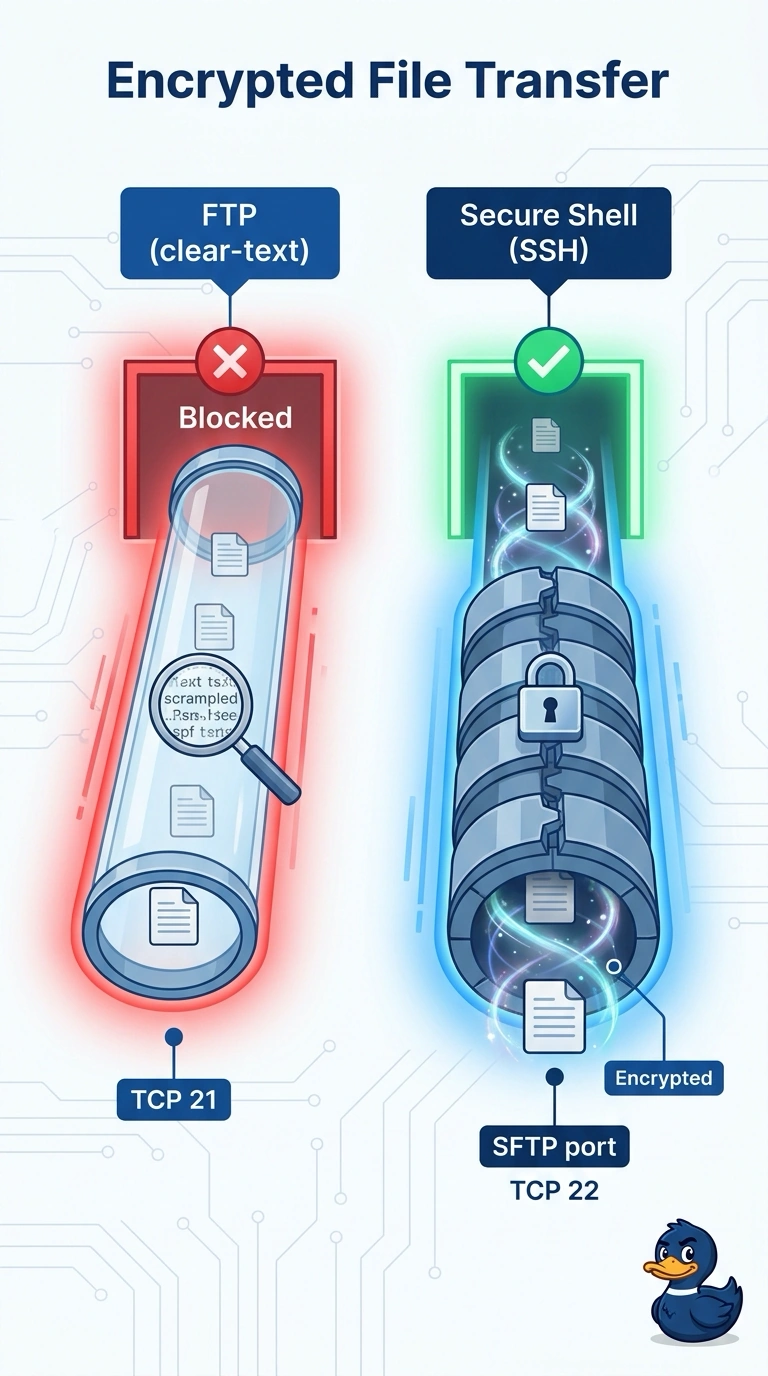
You can protect the payroll transfer by replacing clear-text FTP with SFTP on TCP 22, where the file transfer rides inside Secure Shell. TFTP on UDP 69, Telnet on TCP 23, and HTTP on TCP 80 do not provide the Secure Shell file-transfer service you need.
Full Explanation
FTP on TCP 21 moves files and credentials in clear text, which is what the county office has to stop using for payroll. SFTP is the file-transfer service carried by Secure Shell, and Secure Shell uses TCP 22; replacing the payroll copy with SFTP on TCP 22 encrypts the session and retires the clear-text FTP path. TFTP on UDP 69 is a simple file transfer that does not encrypt payroll files or use Secure Shell, so it would not meet the requirement. Telnet on TCP 23 is a clear-text remote terminal, not a file-transfer replacement for FTP. HTTP on TCP 80 is clear-text web traffic, not the Secure Shell file service required here. Exam caveat: SFTP is not the older FTP protocol with encryption wrapped around it. A product that still speaks FTP, even over a protected path, is a different service from SFTP on TCP 22; the allow rule must permit TCP 22 to the SFTP server while TCP 21 stays closed. Practical check: transfer a test payroll file with SFTP, confirm the session uses TCP 22, and verify that a capture on the path does not reveal the file or password in clear text as FTP did.