
A retail scheduling application runs in a public cloud where many customers share the provider's physical hosts and depend on the provider to isolate them from each other. Which cloud trait is that sharing?
Select an answer to reveal the explanation.
Short Explanation
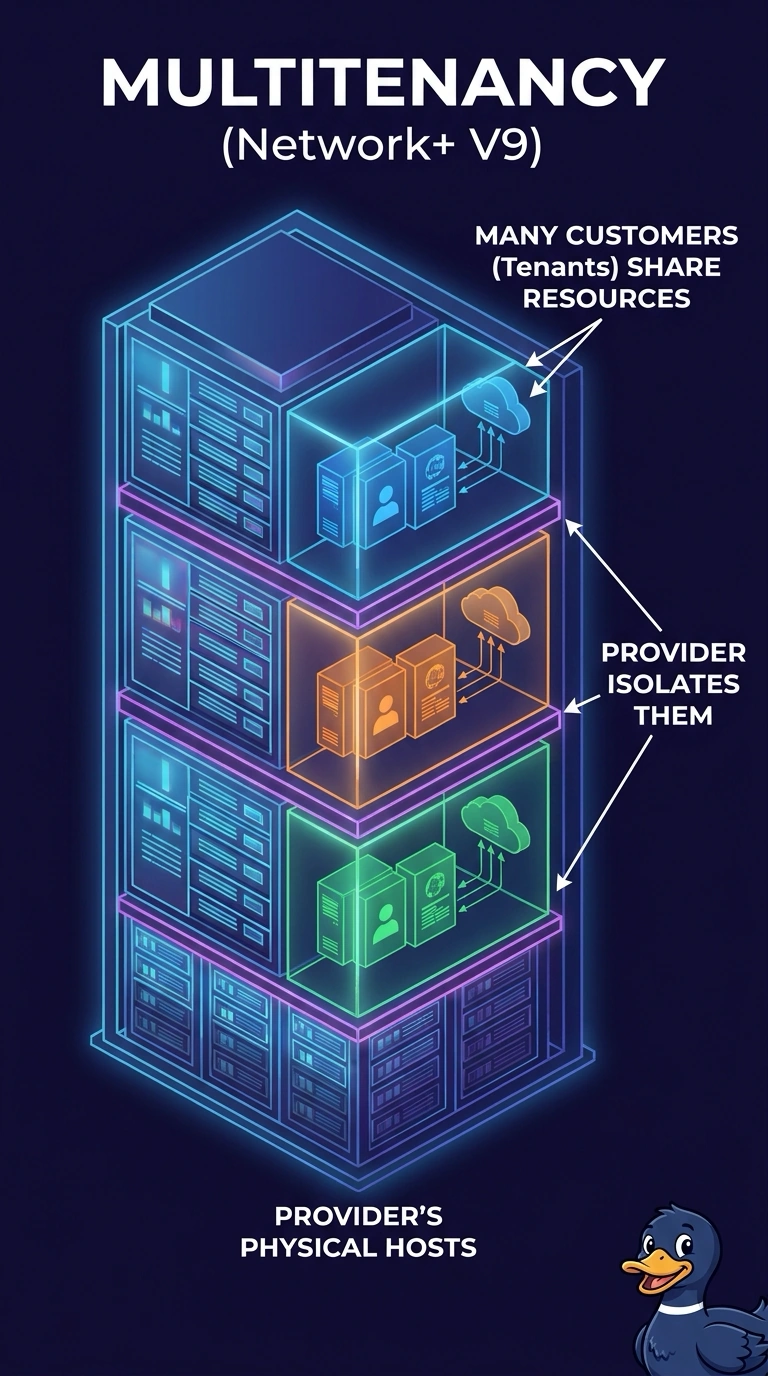
Roommates in one building share the walls and still expect their own locks. You are looking at multitenancy: many customers on the provider's physical hosts, with isolation supplied by the provider. A private cloud for this retailer alone, the ability to grow capacity, or a cloud limited to one industry group is a different trait.
Full Explanation
Multitenancy means several customers run on the same physical cloud hosts, and the provider isolates one customer's compute, network, and storage from another's. The retail application on that public cloud matches: shared hardware, and trust in the provider's separation. A private cloud dedicated to one customer is the opposite of sharing hosts with many others. Elasticity is the tempting twin because public clouds are also elastic. It means capacity can grow or shrink, and it does not name the sharing of physical hosts. A community cloud is limited to organizations with a common interest. This stem is many unrelated customers on a public provider. Exam caveat: multitenancy does not remove the retailer's own access control. The provider isolates tenants, and the retailer still protects its accounts and data. Operational check: read the provider's tenancy description, confirm the hosts are shared, and confirm isolation is the provider's control rather than a private building of the retailer's own.