
A factory aggregation switch needs a transceiver for a 40-gigabit Ethernet port, and the port takes the larger four-lane optic form factor. Which part matches the port?
Select an answer to reveal the explanation.
Short Explanation
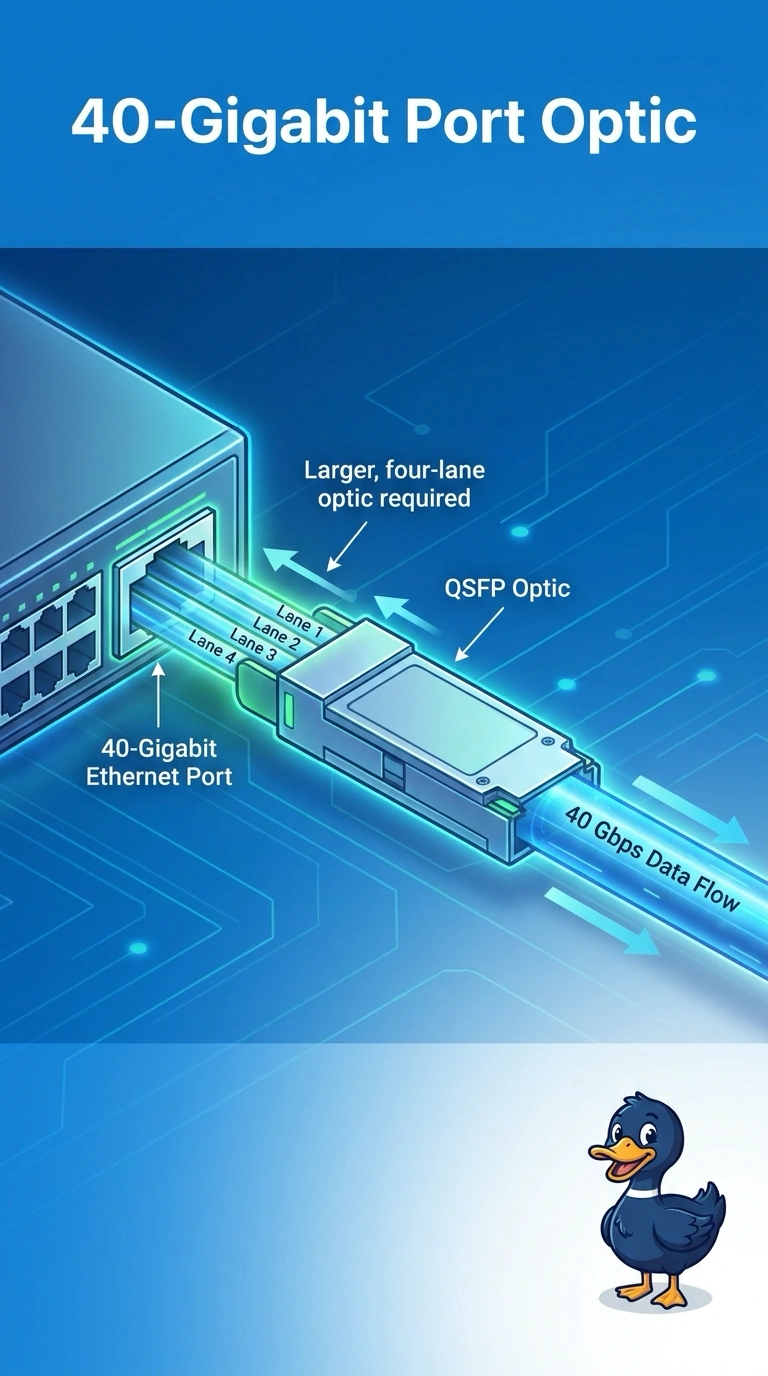
Think of the switch cage as a wide drawer that needs a wide folder. For this 40-gigabit port, you need the larger four-lane QSFP form factor. An SFP, SFP+, or QSFP28 is a different form factor for this port.
Full Explanation
QSFP is the quad, four-lane pluggable form factor required for this 40-gigabit Ethernet port. An SFP is the smaller, single-lane optic, so it will not seat in the larger cage. An SFP+ can be tempting because it is also a modern Ethernet optic, but it is a 10-gigabit, single-lane form factor rather than the four-lane optic this port requires. A QSFP28 belongs to the same broad family, but it is the 100-gigabit form factor, not the part specified for this 40-gigabit cage. Exam caveat: the far end must also match the wavelength and fiber type; two QSFP modules can fail to link if one is for single-mode fiber and the other is for multimode fiber. As a practical check, confirm the switch port specification calls for a QSFP, install a matching module, and verify that the link comes up at 40 gigabits—not 10 or 100. Match the far-end optic as well, since a QSFP in this cage can still fail if the other end has a different lane count. Check the port specification before ordering so a 100-gigabit optic is not installed in this cage.