
A warehouse handheld answers a ping to 127.0.0.1 and still cannot reach any host on the floor. What did the successful ping prove?
Select an answer to reveal the explanation.
Short Explanation
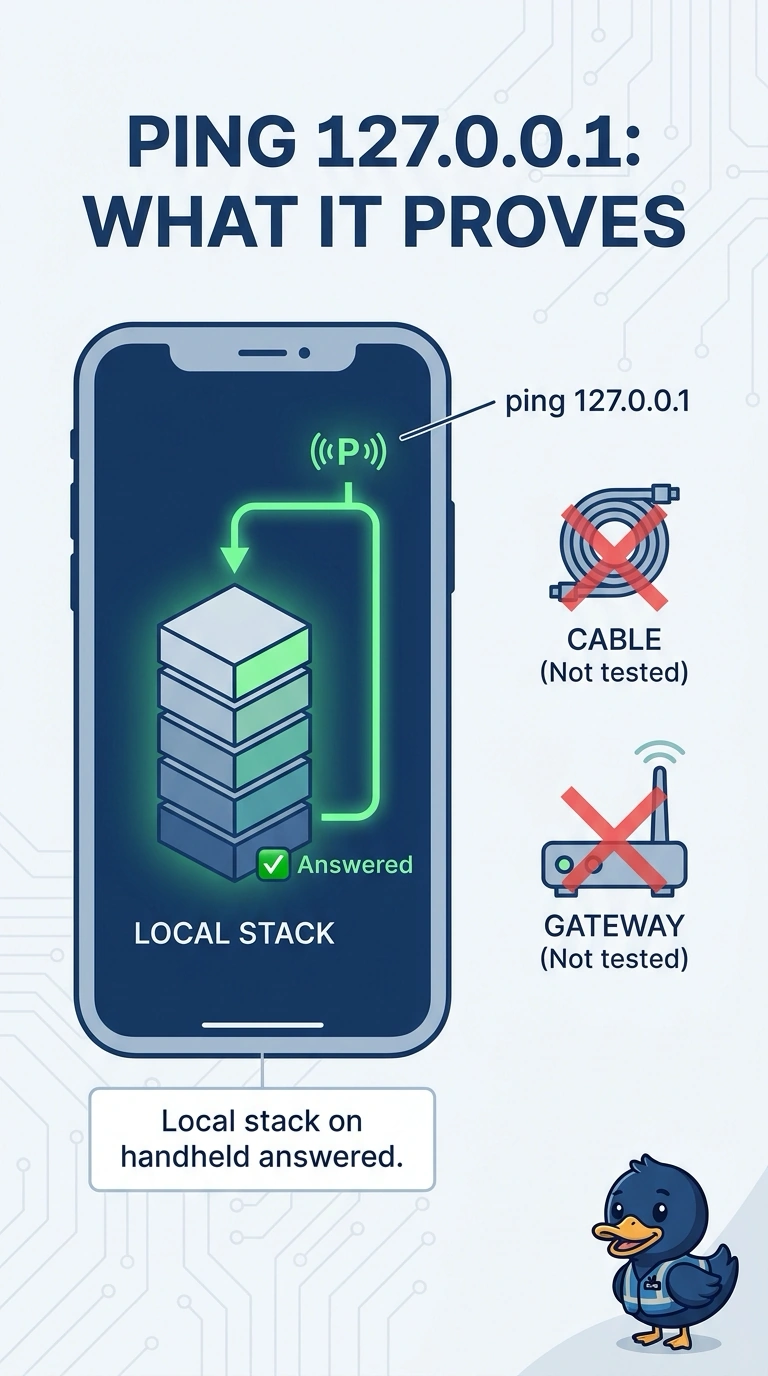
Pinging 127.0.0.1 is knocking on your own front door from the inside. You proved the handheld's local stack answers, and you proved nothing about the floor cable or the gateway, which is why the room is still unreachable. That address is loopback, not a private LAN address, and it never asked DNS for a name.
Full Explanation
The address 127.0.0.1 sits in the IPv4 loopback range 127.0.0.0/8. A packet to it is handled inside the local host and is not transmitted on the LAN. A reply proves the handheld's IP stack can answer itself. It does not prove the network adapter is linked, the cable is good, a switch port is up, or a default gateway forwards anything. That is why the floor can still be unreachable after a successful loopback ping. A default gateway is used for destinations the host believes are off its subnet. Loopback never leaves the host, so the reply is not evidence the gateway forwarded a packet. DNS resolution turns a name into an address. This ping was aimed at a numeric address, so a working reply does not show that any name was resolved. RFC 1918 private space is 10.0.0.0/8, 172.16.0.0/12, and 192.168.0.0/16. Loopback is a separate reservation, 127.0.0.0/8, and 127.0.0.1 is not a private LAN address a floor host would use to reach its neighbors. Exam caveat: a host can answer loopback with its adapter unplugged. Do not accept loopback as a substitute for pinging the gateway and a host on the floor. Operational check: after loopback succeeds, ping the gateway, then ping a floor host by address, and only then test a name, so each step adds one new piece of the path.