
A thrift-store counter still uses a hub between the register and the wall. Every bit that arrives on one hub port is repeated out of the other ports, and the hub never reads a MAC address or an IP address. Which OSI layer is that behavior?
Select an answer to reveal the explanation.
Short Explanation
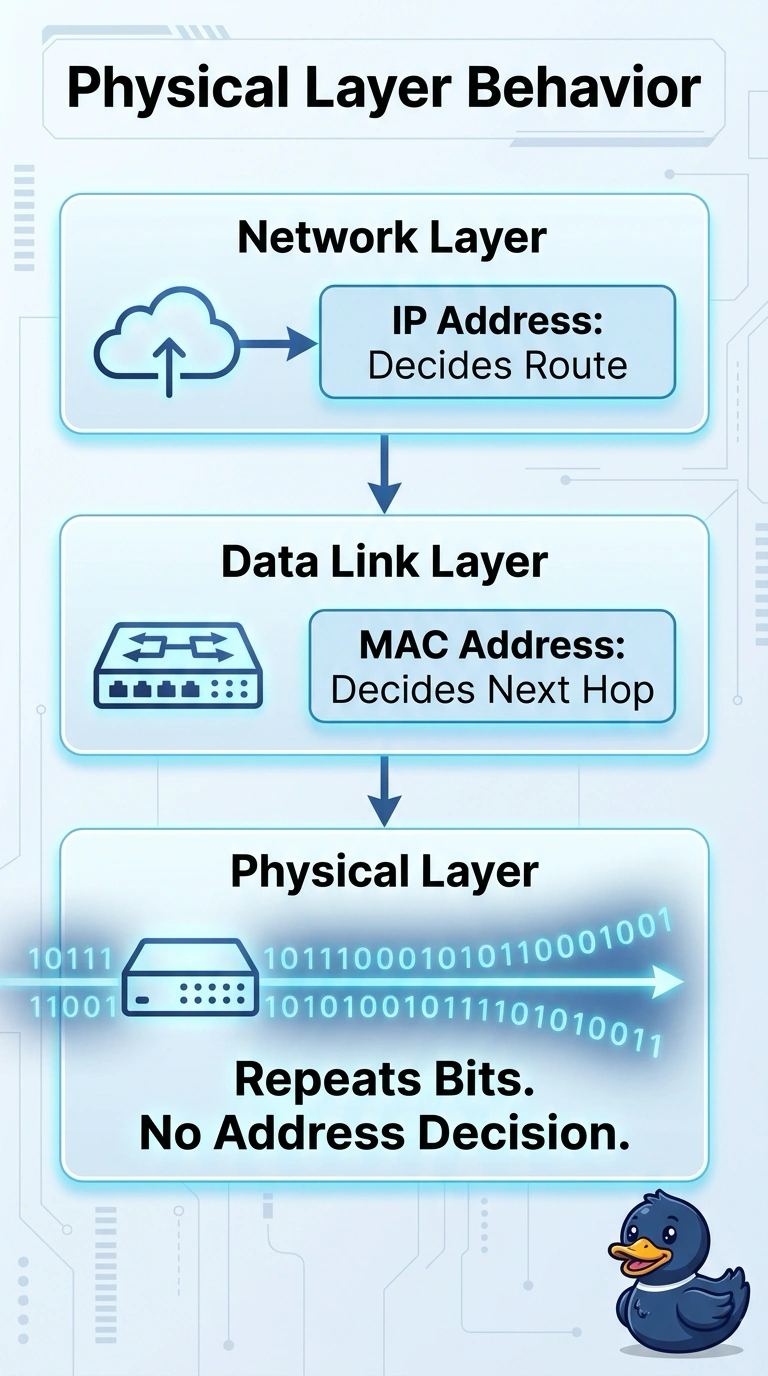
A hub is a hallway that shouts every sound into every room. You are looking at a device that copies bits out of every other port and never consults a MAC address or an IP address, which is physical-layer behavior. A switch, a router, and a proxy each stop to read something this hub ignores.
Full Explanation
On the OSI model this exam uses, the physical layer moves bits across the medium. A hub is a multiport repeater: a signal that arrives on one port is regenerated out of the other ports, and the device does not build a table or choose a destination. That matches the thrift-store box, which never reads a MAC address or an IP address. The data-link layer is where a switch learns MAC addresses and forwards a frame to a particular port. A hub does not make that decision, so calling the behavior data-link describes a switch instead. The network layer is where a router forwards a packet by its destination IP address and can rewrite the next hop. The hub has no IP forwarding table. The application layer is where a proxy understands a client request and opens its own connection onward. Repeating bits is not application relaying. Exam caveat: everyone attached to the hub shares one collision domain, so a busy register and a busy office PC contend with each other even though no address is examined. Operational check: if a capture on one hub port shows frames whose destinations are other devices, the box is flooding like a hub, and replacing it with a switch is what adds MAC forwarding.