
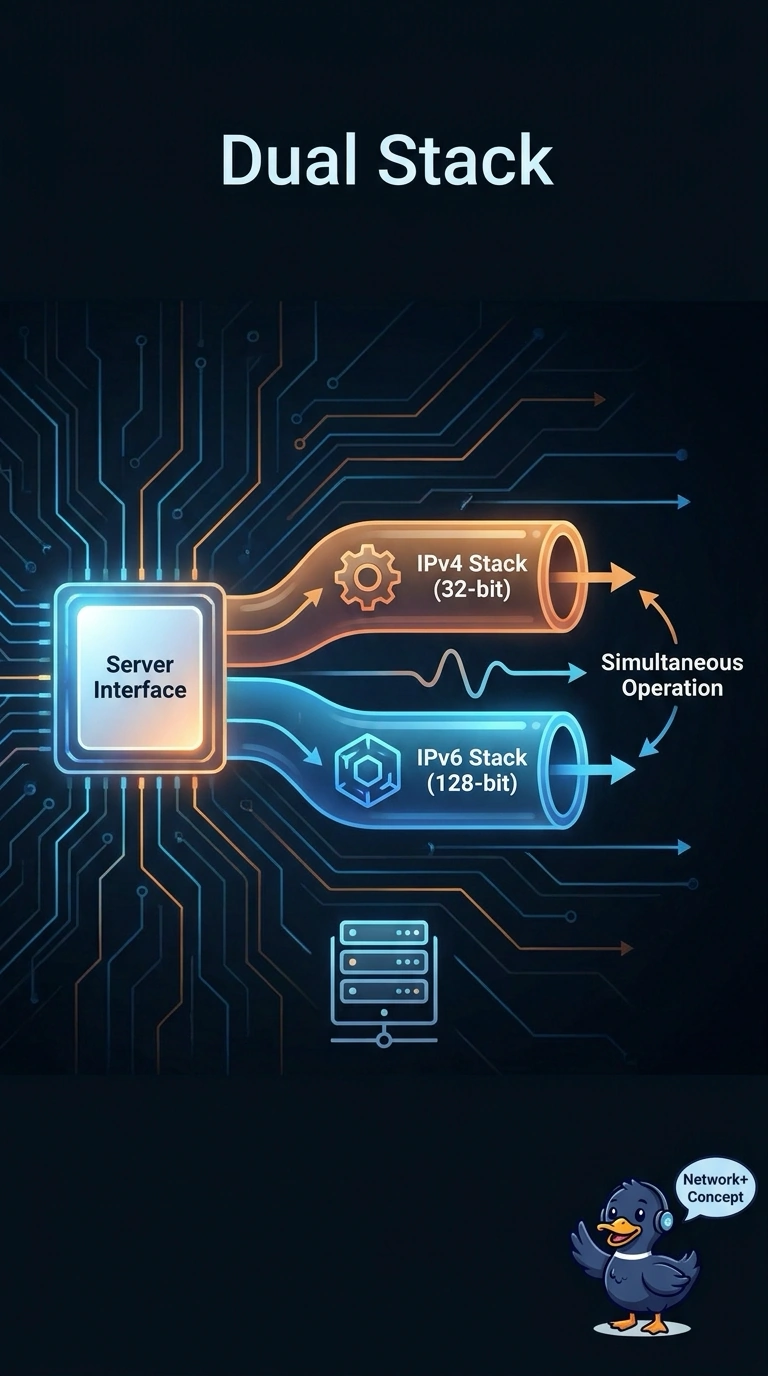
During a campus migration, each server must keep its IPv4 address and also run IPv6 on that same interface. Which approach is this?
Select an answer to reveal the explanation.
Short Explanation
You can keep the old phone line and plug in a new one on the same desk. Dual stack does that with addresses: IPv4 stays, and IPv6 is added on the same interface. Translation for an IPv6-only client, a tunnel that takes IPv4 away, or dropping IPv4 is a different job.
Full Explanation
Dual stack means a host or router runs IPv4 and IPv6 at the same time on the same interfaces. Applications that still speak IPv4 keep working, and IPv6 speakers use the new address, which is exactly the campus migration requirement. Nothing is translated and nothing is removed. NAT64 is a translation mechanism that lets IPv6-only clients reach IPv4 destinations. It assumes one side is not running IPv4. These servers must keep IPv4, so translation is the wrong tool and would hide the IPv4 address the migration is required to retain. A tunnel can carry one protocol inside another, and some transition designs use tunnels, but a tunnel whose effect is to remove IPv4 from the server violates the requirement to keep IPv4 on the interface. The servers need both protocol stacks present, not IPv6 substituted for IPv4. IPv6-only on the servers is the other half of a migration, and it drops the IPv4 address the stem says must stay. Exam caveat: dual stack doubles the exposure. Firewall policy, management access, and neighbor discovery all have to be reviewed for IPv6, or the new stack becomes an unfiltered path. Operational check: on each migrated server, confirm the interface still holds its IPv4 address and also shows an IPv6 address, then pass a test to an IPv4 peer and an IPv6 peer.