
Two data halls must extend the same VLAN across a layer-3 underlay between them. Which technology encapsulates the original layer-2 frame so that VLAN can cross the underlay?
Select an answer to reveal the explanation.
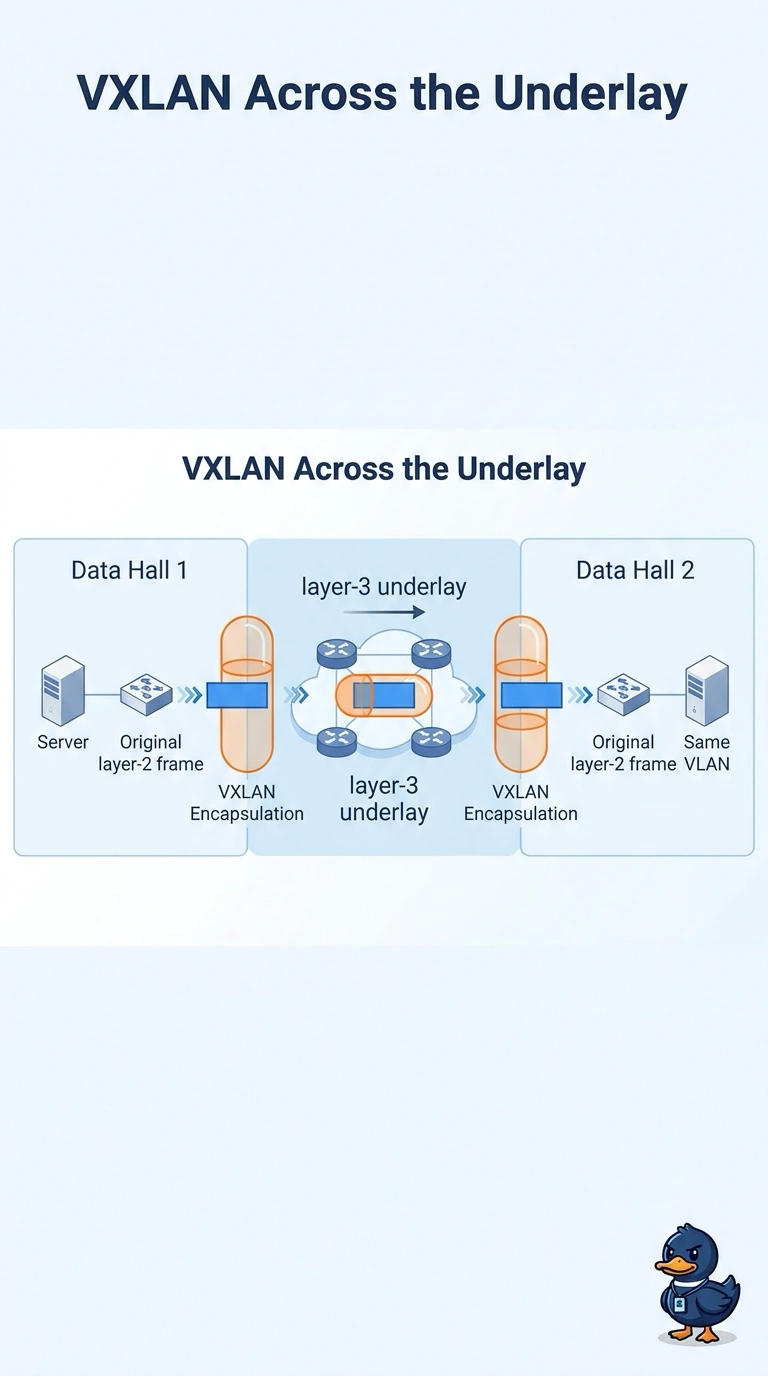
Short Explanation
VXLAN is a shipping crate for a layer-2 frame. You put the original frame in the crate, carry it across the layer-3 underlay between the data halls, and open the same VLAN on the other side. A trunk tag does not survive a routed underlay, and picking a WAN circuit does not pack the frame.
Full Explanation
VXLAN extends a layer-2 segment across a layer-3 network by encapsulating the original Ethernet frame and forwarding that packet across the underlay. The two data halls keep one VLAN even though the path between them routes. A plain 802.1Q trunk is the tempting substitute, because the VLAN is already tagged, and a tag is not a tunnel. The underlay routes, so the trunk does not extend across it. SD-WAN selects a transport from central policy. It can steer an application, and it does not encapsulate an Ethernet frame so a VLAN can cross. Giving each hall a new VLAN number builds two segments. The requirement is the same VLAN on both sides. Exam caveat: both ends must map that VLAN to the same VXLAN segment, and the underlay must forward the encapsulated traffic. A mismatched mapping puts the halls in different segments. Operational check: confirm both halls use the same segment identifier, confirm the underlay path is up, and confirm a host in one hall can ARP for a host in the other on that VLAN.