
A campus lab needs addresses for 100 usable hosts and wants the smallest common prefix that still fits them. Which prefix should be assigned?
Select an answer to reveal the explanation.
Short Explanation
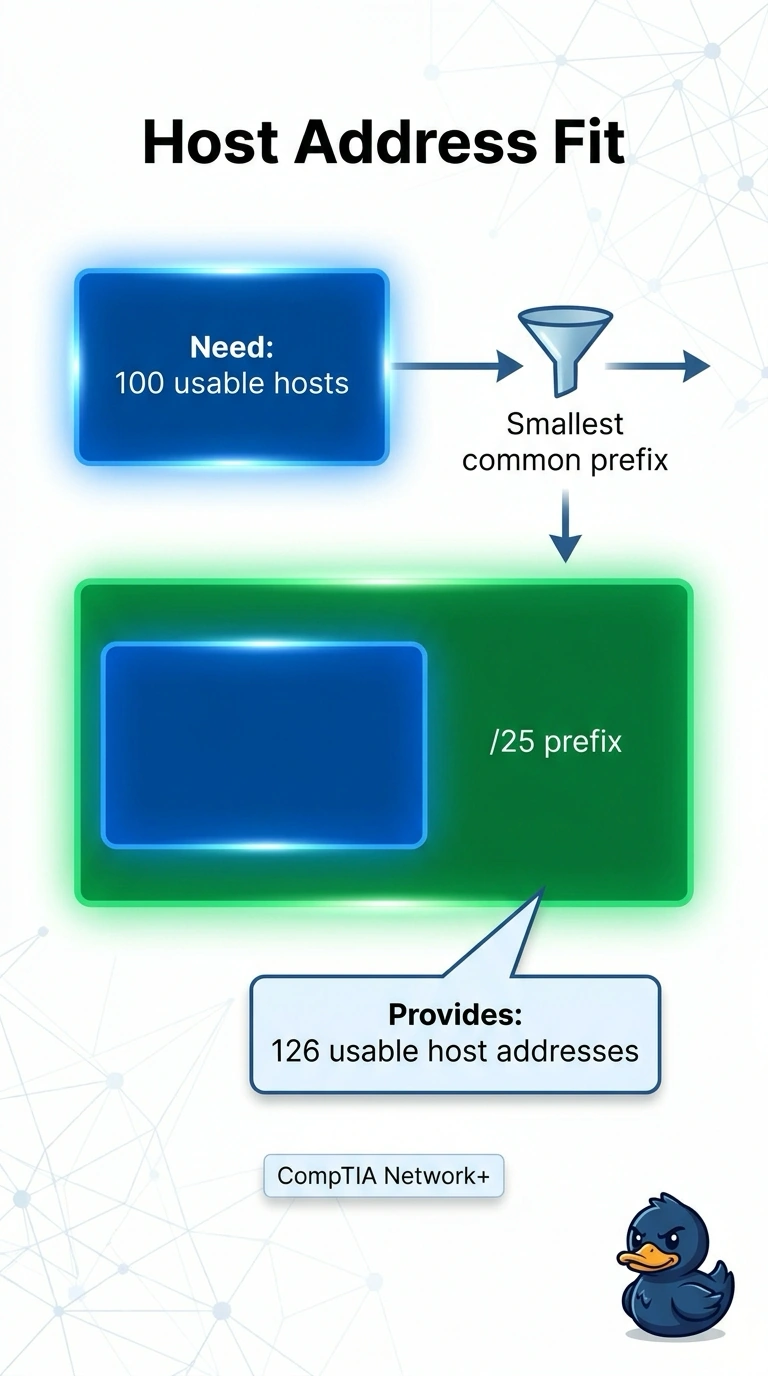
You’re choosing an address block like a table that seats the whole class. A /25 gives you 126 usable hosts, enough for 100, and is the smallest listed prefix that fits. A /26 provides only 62 usable addresses, so it leaves people standing.
Full Explanation
Usable IPv4 hosts in a prefix are calculated by raising two to the number of host bits, then subtracting the network address and the broadcast address. A /25 leaves 7 host bits: 2 to the 7th power is 128 addresses, and 128 minus 2 is 126 usable hosts. Since the lab needs 100 usable hosts, a /25 fits. It is the smallest listed prefix that works: the next longer listed prefix, /26, leaves 6 host bits, giving 2 to the 6th power, or 64 addresses; subtracting 2 leaves 62 usable, which is short of 100. A /27 leaves 5 host bits, giving 32 total addresses and 30 usable, also too few for the lab. A /30 leaves 2 host bits, giving 4 total addresses and 2 usable; that size is suited to a point-to-point link, not a 100-host lab. Exam caveat: subtracting two assumes the prefix reserves a network address and a broadcast address, as these common IPv4 prefixes do; do not mistake the total addresses for the usable-host count. Practical check: compare the requirement of 100 usable hosts with the /25 capacity of 126 and the /26 capacity of 62, assign the /25, and record its network and broadcast addresses so they are not assigned to computers.