
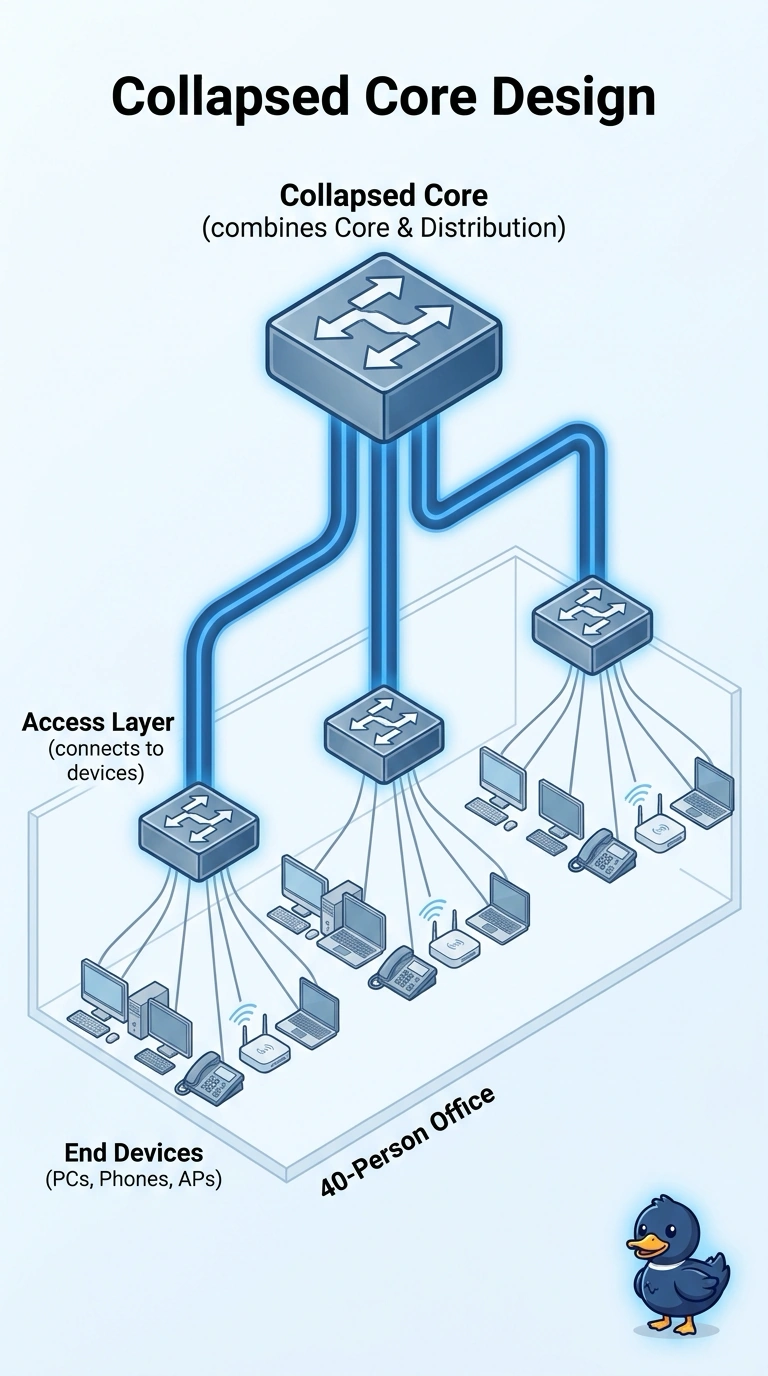
A 40-person office does not need a separate core tier and a separate distribution tier. Which design keeps an access layer and merges those two upper tiers?
Select an answer to reveal the explanation.
Short Explanation
A small office does not need a separate highway and a separate set of interchanges. You collapse the core and distribution into one tier, a collapsed core, and keep access switches for the desks. Spine-and-leaf is a data-center fabric, and dropping the access layer is not the merge the office asked for.
Full Explanation
A three-tier campus design separates access, distribution, and core. A 40-person office rarely needs a distinct core and a distinct distribution layer. A collapsed core combines those two upper roles in one tier, while access switches remain. Keeping the three tiers is the design the stem says the office does not need. Spine-and-leaf gives servers an even hop count by connecting each leaf to every spine. It is a data-center fabric, and it is not a campus access layer under a merged core and distribution. Removing the access switches and landing users on the core does collapse a drawing, and it removes the access layer the requirement says to keep. Exam caveat: a collapsed core still needs redundant uplinks if one switch failure is unacceptable. Operational check: draw access switches uplinked to the combined core-distribution switches, confirm there is no third tier, and confirm user ports terminate on the access switches. Count the hops from a desk to the wide-area edge and confirm that path uses the merged tier only once.