
A factory training video must reach many subscribed receivers, must not be delivered to every host on the subnet, and must not be copied once per viewer. Which delivery method fits?
Select an answer to reveal the explanation.
Short Explanation
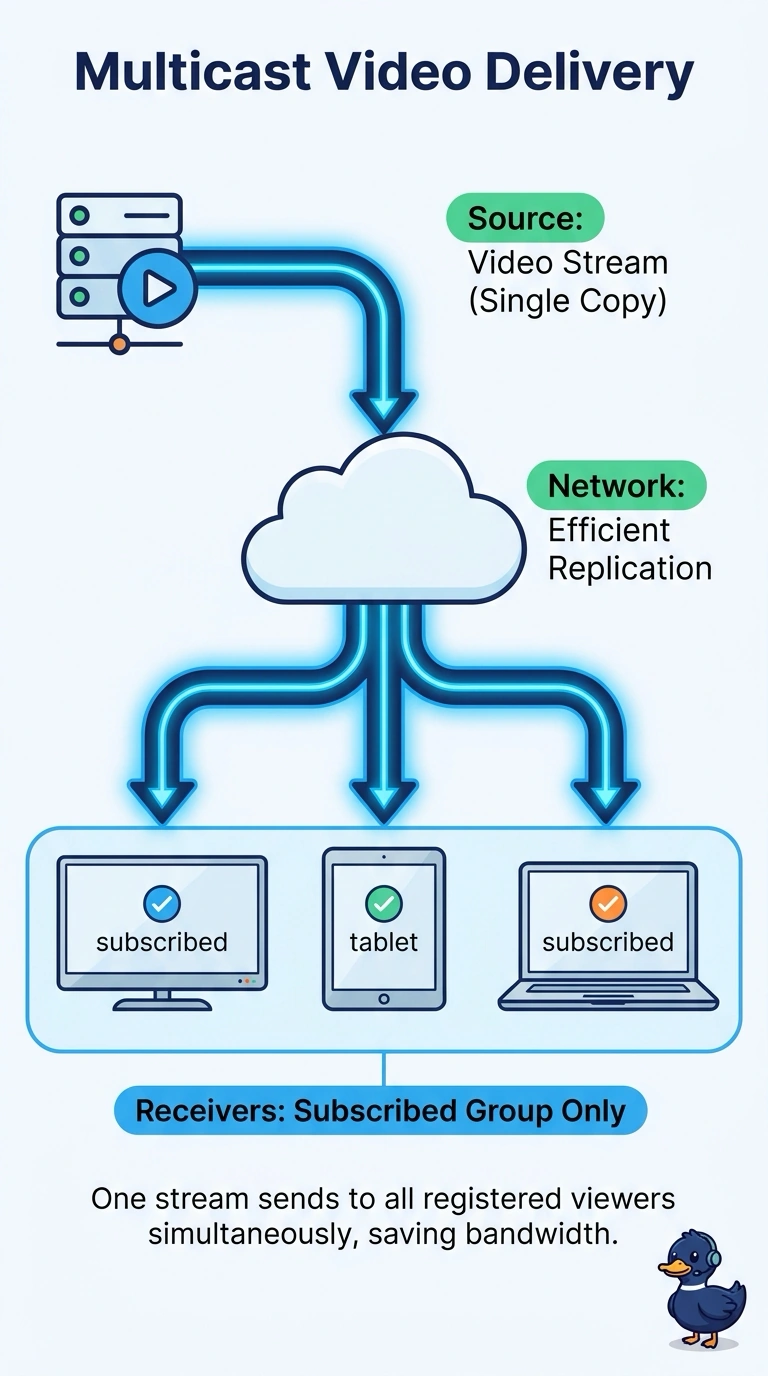
Multicast is one announcement on the intercom that only the radios tuned to that channel play. You need the training video to reach many subscribers without shouting at every host and without packing a separate copy for each viewer. Broadcast hits everyone, anycast picks one nearest target, and unicast builds the private copy the stem ruled out.
Full Explanation
Multicast sends one flow to a group address. Only hosts that have joined the group receive it, and the network replicates the flow where paths diverge instead of accepting a separate unicast stream from the source for every viewer. The training video needs many subscribed receivers, must not hit every host, and must not build a private copy per viewer, which is the multicast pattern. Broadcast delivers a frame to every host in the broadcast domain. It reaches the subscribers and also the hosts that never joined, which the stem forbids. Anycast advertises one address from several places and delivers a given packet to the single nearest instance. That is one receiver, not the group. Unicast can reach every subscriber, and it does it by a separate copy per viewer, which is the pattern the stem rules out. Exam caveat: multicast still needs group management and routing support on the path. A switch that turns the group into a flood can make multicast look like broadcast until that support is in place. Operational check: start the video, confirm subscribers receive it, confirm a host that did not join the group does not, and confirm the source is sending one group flow rather than one stream per viewer.