
A customer needs an isolated virtual network inside a public cloud, kept separate from other customers' networks. Which construct provides that isolation?
Select an answer to reveal the explanation.
Short Explanation
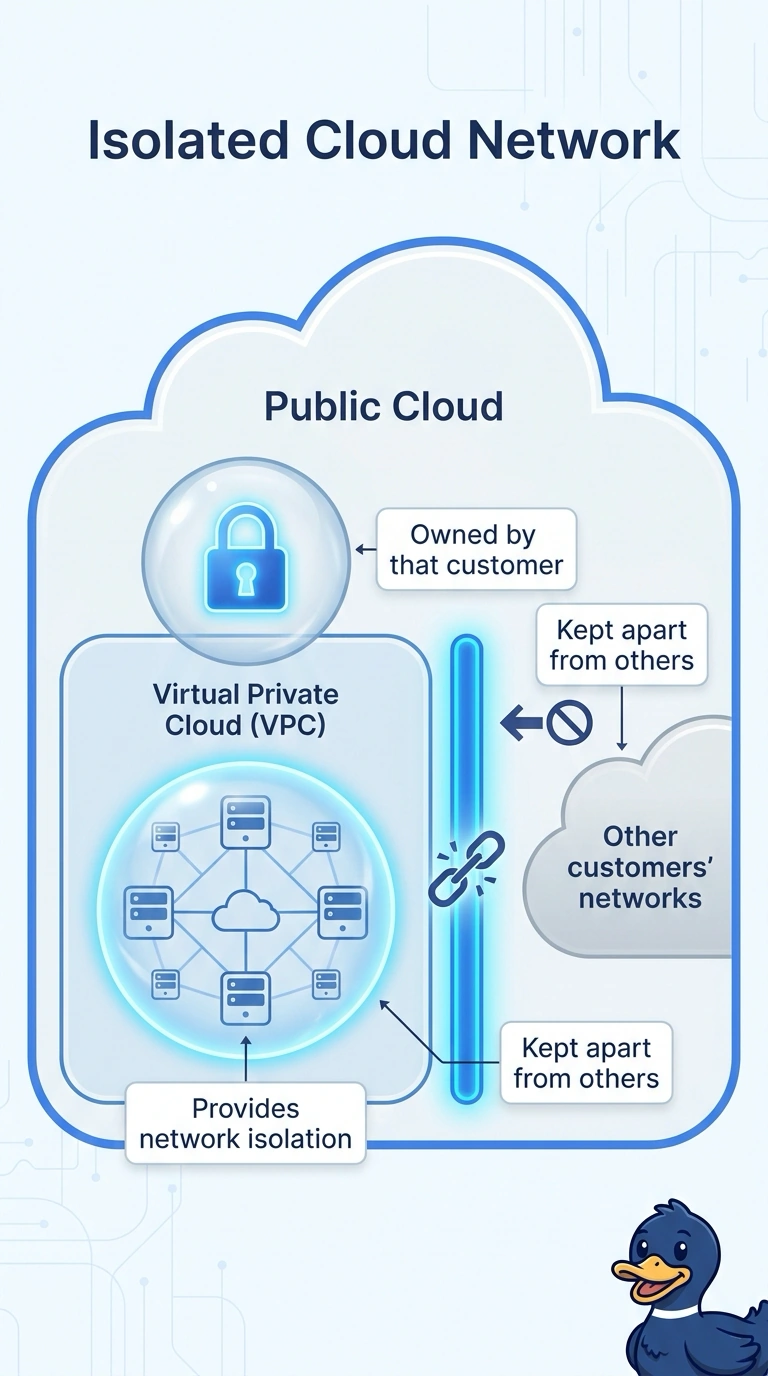
A virtual private cloud is a fenced lot inside a public industrial park. You get your own address space and your own virtual network, separate from the other customers in the same cloud. A region is the park, a VPN is the road to it, and extra servers do not build the fence.
Full Explanation
A virtual private cloud is a logically isolated section of a public cloud, with the customer's own address ranges, subnets, and route tables. Other customers have their own virtual networks. That isolation is what was asked for. A public region is the near miss. The customer does run inside a region, and the region is shared infrastructure, not the private network that keeps this customer's addresses and routes apart. A site-to-site VPN can connect the customer's office to a cloud network that already exists. The tunnel is not the isolated construct. Elasticity adds and removes capacity. It does not define a separate virtual network. Exam caveat: the virtual private cloud is isolated by configuration. A wide rule or an unplanned peering can open a path out of it. Operational check: review the virtual network's address space and confirm security rules do not permit other customers' networks. Check peering and a wide any-to-any rule before you call the fence closed. A VPN into the cloud still needs this network to land on.