
Clinic laptops are forced off an access point every few minutes. The log shows the access point sending disassociation frames. Signal is strong and channels do not overlap. Which condition is this?
Select an answer to reveal the explanation.
Short Explanation
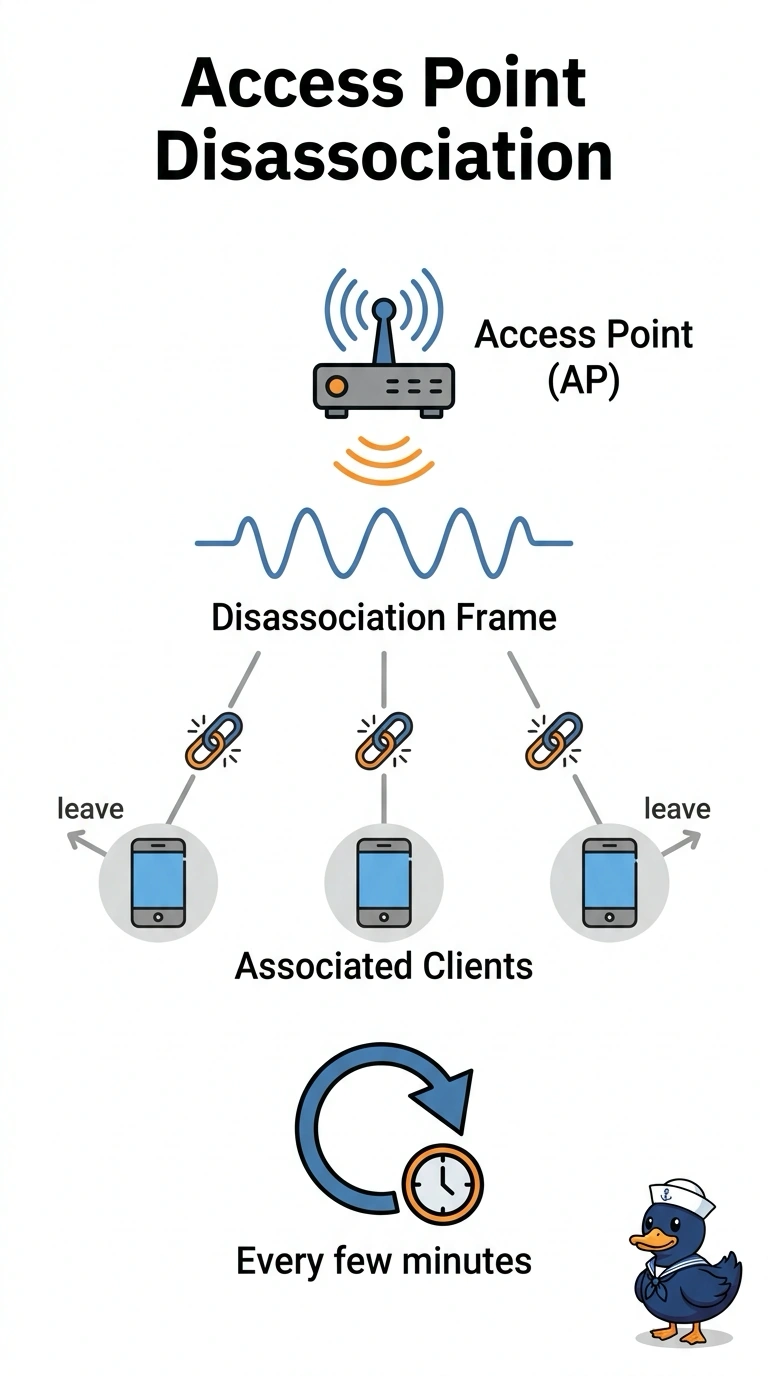
The access point is not whispering. It is telling the laptops to leave, and you can read that goodbye in the log while the signal stays strong and the channels do not overlap. The condition in front of you is disassociation.
Full Explanation
Disassociation is the 802.11 exchange in which an access point or a client ends the association. The clinic log shows the access point sending those frames and the laptops are forced off, while the signal is strong and the channels do not overlap, so the condition is disassociation rather than a coverage or overlap problem. A coverage hole is a weak-signal area. A strong signal contradicts it. Wide-area jitter is variation in delay across the WAN. It does not create 802.11 disassociation frames. A duplex mismatch is a copper Ethernet problem on a wired link. It does not write disassociation entries in a wireless log. Exam caveat: disassociation is the symptom. The cause may be a policy, a client driver, or an attacker sending spoofed management frames, so the log line is the start of the search. Operational check: note which access point sends the frames, check its load and security policy, and capture the management frames if you suspect spoofing. Note the time of the disassociation and ask whether a policy or a new client driver changed at that minute.