
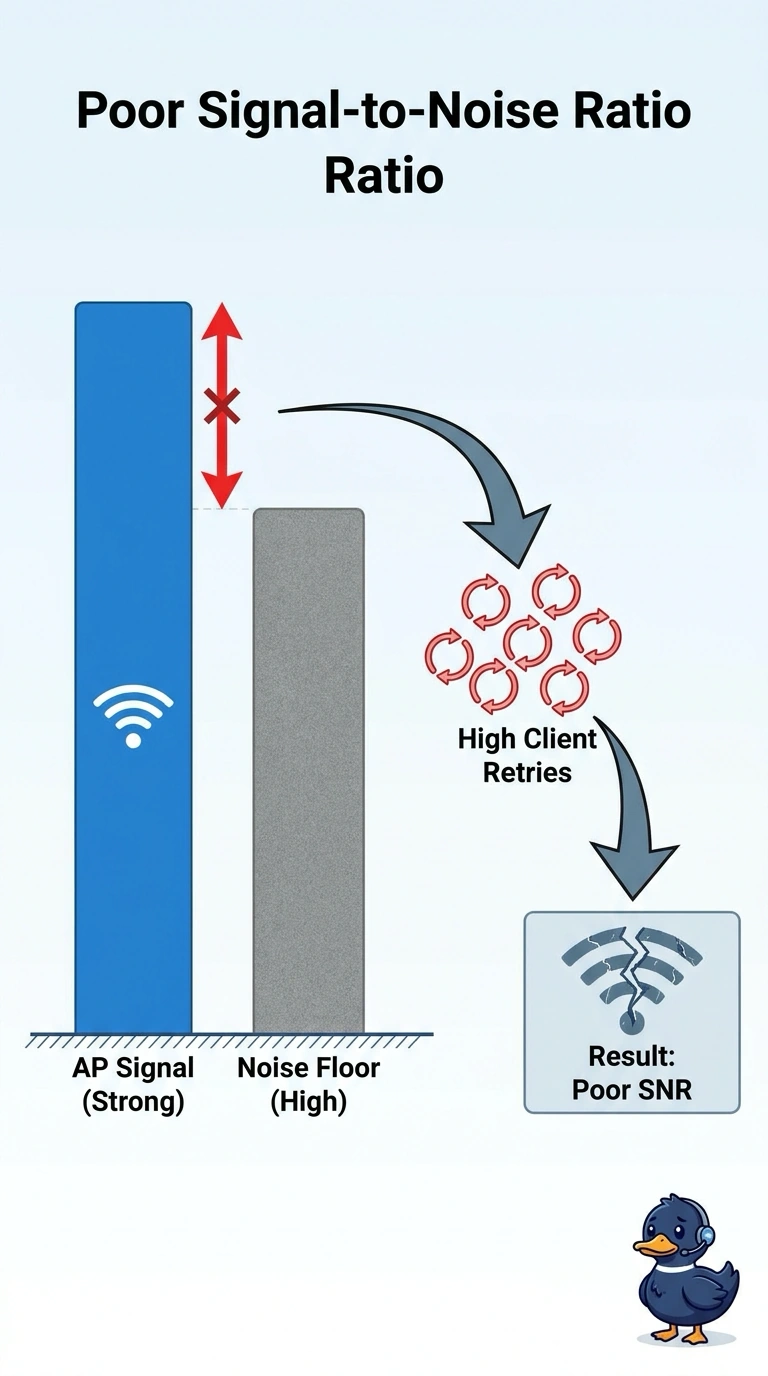
On a hospital floor the signal level from the access point is strong, the noise floor is also high, and clients show high retries. Neighboring radios are not on overlapping channels. Which problem is this?
Select an answer to reveal the explanation.
Short Explanation
The station is loud, and so is the static, so you still cannot make out the words. A strong signal with a high noise floor is a poor signal-to-noise ratio, and the retries follow. You are not out of range, the WAN circuit did not invent that noise, and a reverse DNS record does not live on the radio.
Full Explanation
Signal-to-noise ratio compares the desired signal with the noise floor. A strong received signal can still be unusable when the noise is high, because the client cannot distinguish the frames, and retries climb. The hospital floor matches that pattern, and overlapping channels have already been ruled out as the interference source. A coverage hole is a weak-signal area. A strong signal is the opposite finding. Wide-area bandwidth limits how fast the site can talk to the internet. It does not raise the RF noise floor next to an access point. A missing PTR record can affect reverse-lookup checks such as some mail policies. It does not increase wireless retries. Exam caveat: noise can come from non-Wi-Fi devices, a bad radio, or a nearby transmitter, so removing channel overlap does not end the search. Operational check: measure signal and noise at the client, identify the noise source, and confirm the retry rate falls after that noise is removed. Look for a non-Wi-Fi noise source if the analyzer shows a high noise floor and no overlapping network name.