
Hotel guests in the lobby report slow Wi-Fi. The technician needs the nearby network names, the channels they use, and the signal level at that spot. Which tool shows that?
Select an answer to reveal the explanation.
Short Explanation
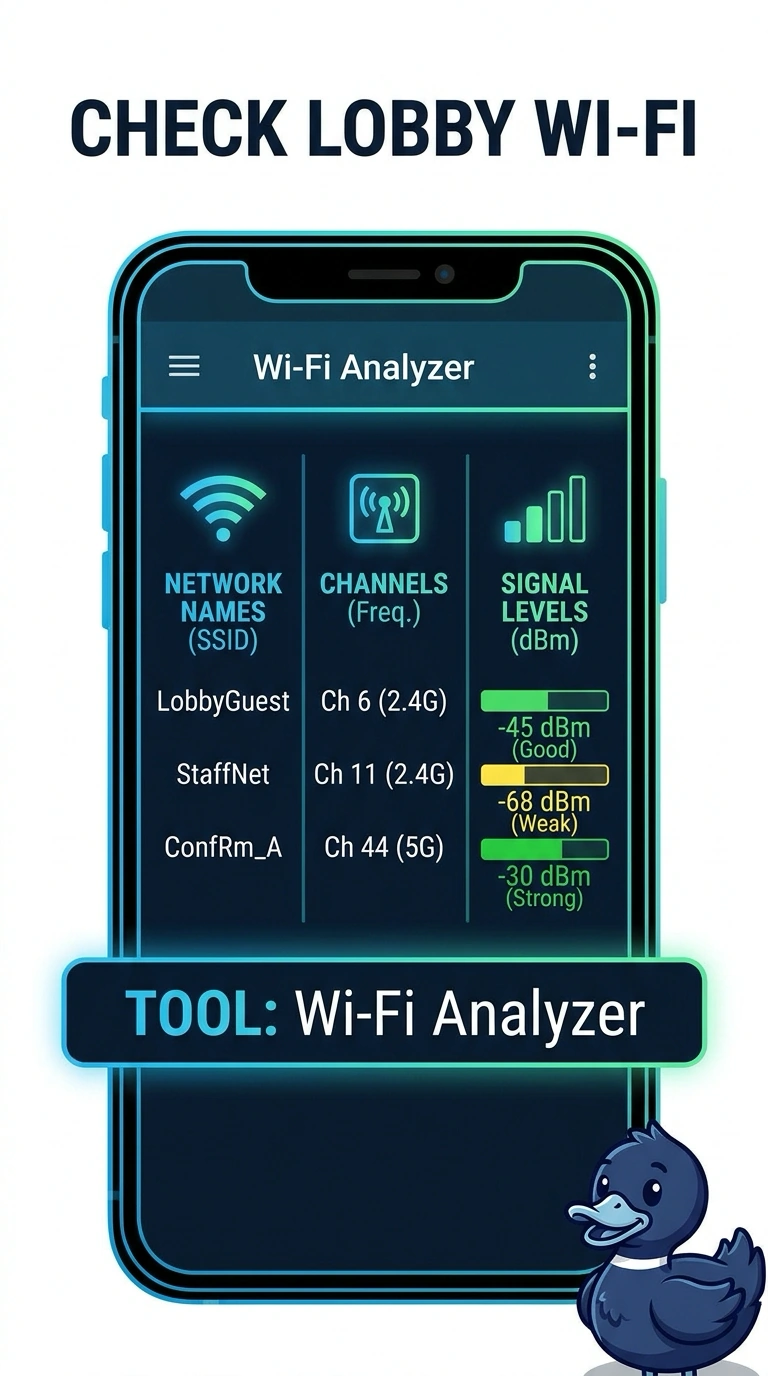
You are standing in the lobby trying to see which radios are shouting over each other. A Wi-Fi analyzer is the tool that listens to the air and lists the names, the channels, and how strong they are where you stand. A toner follows a copper pair, a red light finds a fiber bend, and the routing table does not contain channel numbers.
Full Explanation
A Wi-Fi analyzer passively listens to 802.11 beacons and probes and displays each SSID it hears, the channel and channel width, and the signal level at the analyzer's location. That is the view the technician needs in the lobby. A tone generator places an analog tone on a copper pair, and an inductive probe finds that pair at the patch panel. It does not receive radio beacons or report channels. A visual fault locator injects visible light into a fiber so a break or a sharp bend can be seen. It does not decode wireless network names. A routing table lists prefixes and next hops. It has no column for an SSID or a 2.4 or 5 GHz channel. Exam caveat: the analyzer shows what is on the air at that spot. A full predictive survey or a heatmap is a different job, done to plan coverage rather than to identify the channels colliding in the lobby right now. Operational check: stand where the guests complain, record the overlapping channels and signal levels, and then change the hotel's channel plan based on what the analyzer displayed.