
A school will not accept a new copper run until length, wiremap, and crosstalk have been measured and passed. Which tool produces that acceptance test?
Select an answer to reveal the explanation.
Short Explanation
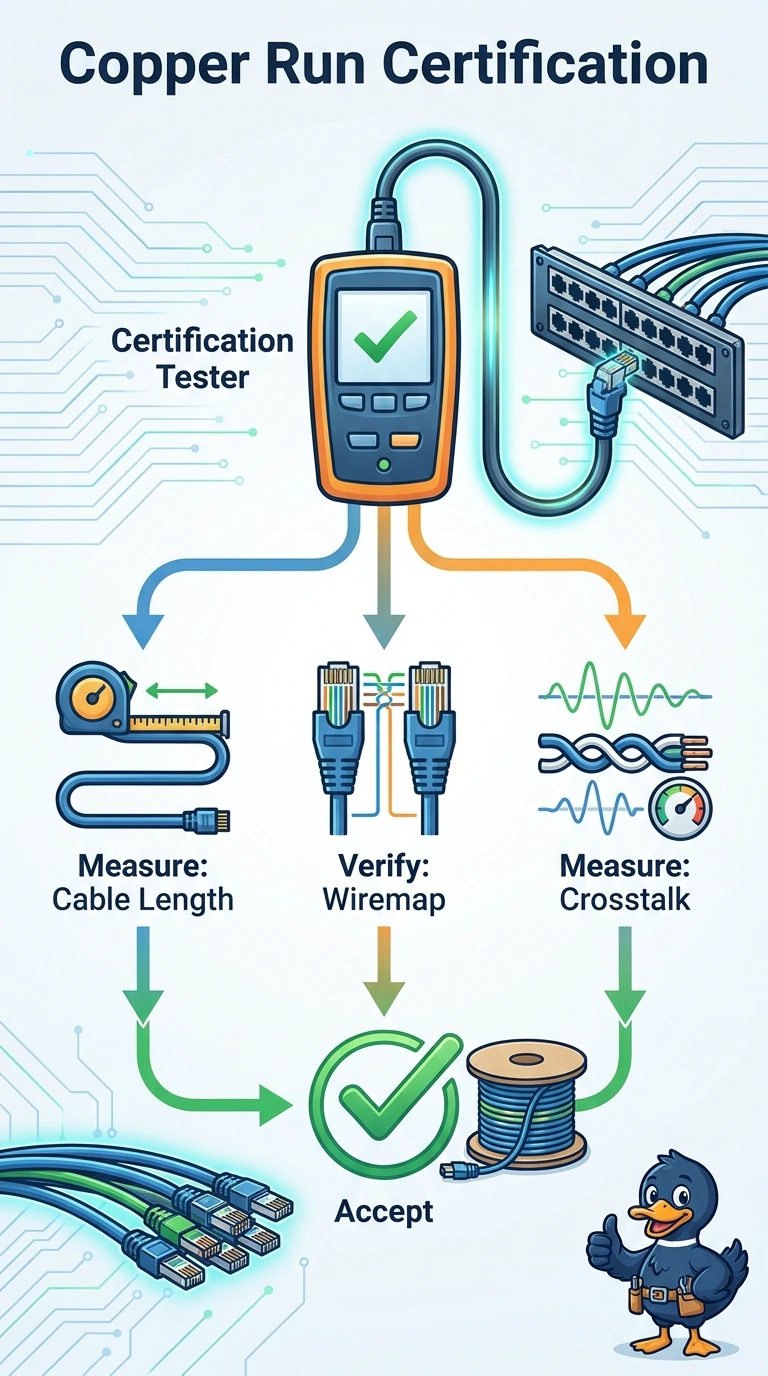
When you accept a new cable, you want a report card, not just a way to find its jack. A certification tester checks length, wiremap, and crosstalk. A tone generator and probe locates a pair, a Wi-Fi analyzer checks wireless signals, and a routing table does not grade cable.
Full Explanation
A certification tester, sometimes called a certifier, measures a copper run against the applicable category standard, including length, wiremap, and crosstalk, and produces a pass or fail. That is the acceptance test the school requires before trusting a new run. A tone generator and probe can locate which pair at the panel corresponds to a jack, but they do not measure crosstalk or certify the run. A Wi-Fi analyzer displays wireless names, channels, and signal; it does not test horizontal copper. The core routing table lists prefixes and next hops, so it neither records a wiremap nor provides a cable certification result. Exam caveat: checking only some cable properties is not equivalent to certification; a run can appear connected yet still fail the required performance checks, including crosstalk or length. Operational check: certify the run to the category printed on the cable jacket, save the result with the cable identifier, and repair terminations before accepting a fail. Keeping the certifier report with that identifier lets the next technician confirm that the run passed.