
A hotel internet circuit is sold as 500 megabits per second of capacity. During a busy evening, a successful file transfer measures about 180 megabits per second. Which term names that measured 180?
Select an answer to reveal the explanation.
Short Explanation
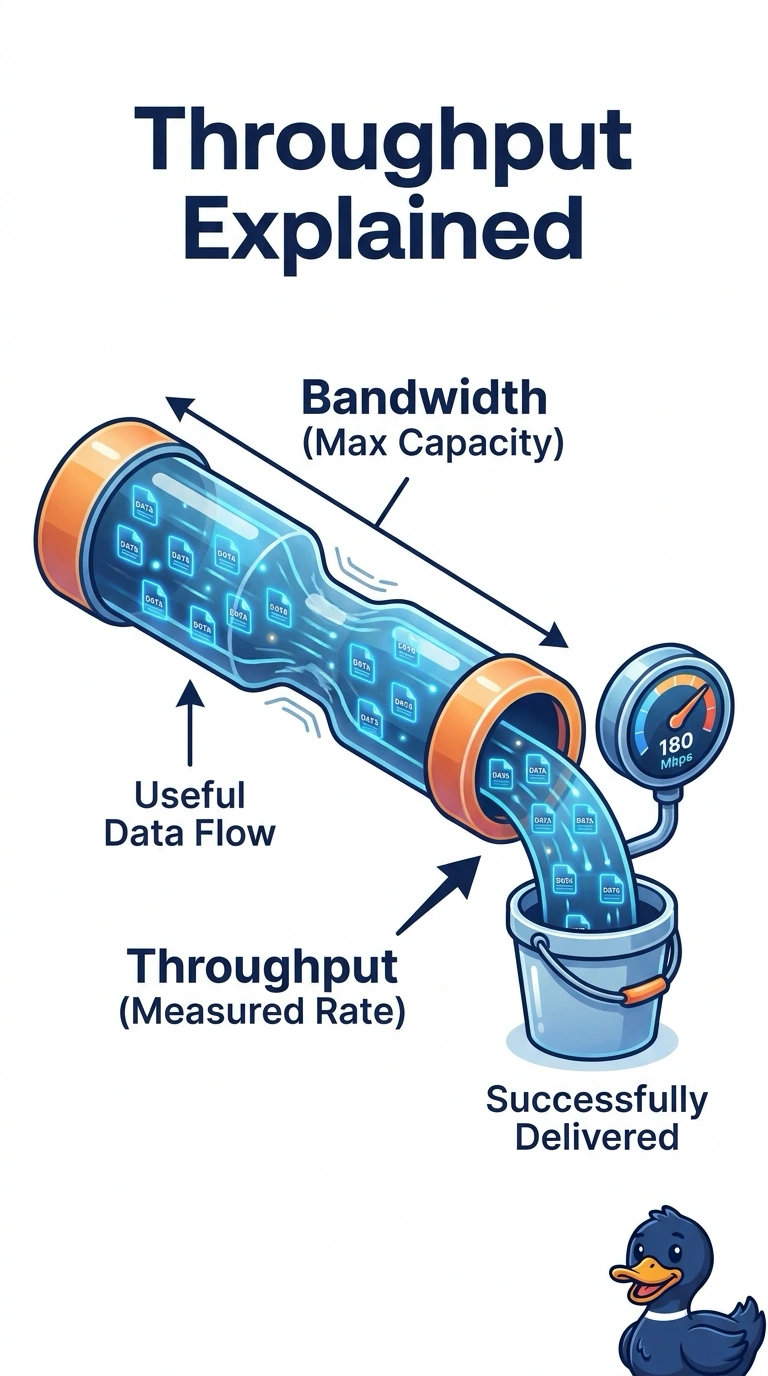
The pipe was sold as wide enough for 500, and the water you actually caught in the bucket was about 180, so the sold width is bandwidth and the water in the bucket is throughput. Jitter is how uneven the arrival times are, and a recovery objective is about how much data you can stand to lose, not how full the pipe is.
Full Explanation
Bandwidth is the capacity of the path, here the 500 megabits per second the circuit is sold to carry. Throughput is the rate at which data successfully arrives, which the file transfer measured at about 180 megabits per second during the busy evening. Congestion, loss, and limits elsewhere on the path can hold throughput below the sold bandwidth. Calling the measurement bandwidth erases that distinction and treats the achieved rate as if it rewrote the circuit's capacity. Jitter is variation in delay between packets. It is measured in time, not as a megabit-per-second transfer rate. A recovery point objective is the amount of data loss a service can accept, expressed as time. It is not the capacity written on a circuit order, and it is not a throughput figure. Exam caveat: a speed test also reports throughput, and a single busy-evening sample does not prove the provider failed to deliver the sold bandwidth. Operational check: measure more than once, compare throughput with interface utilization and loss counters, and open a provider ticket only when the delivered rate stays below the contracted bandwidth outside a known congestion window.