
A retail user reports that the Wi-Fi is down and, separately, that a receipt printer is jammed. Nothing in the report links the two complaints. Which approach follows the troubleshooting method?
Select an answer to reveal the explanation.
Short Explanation
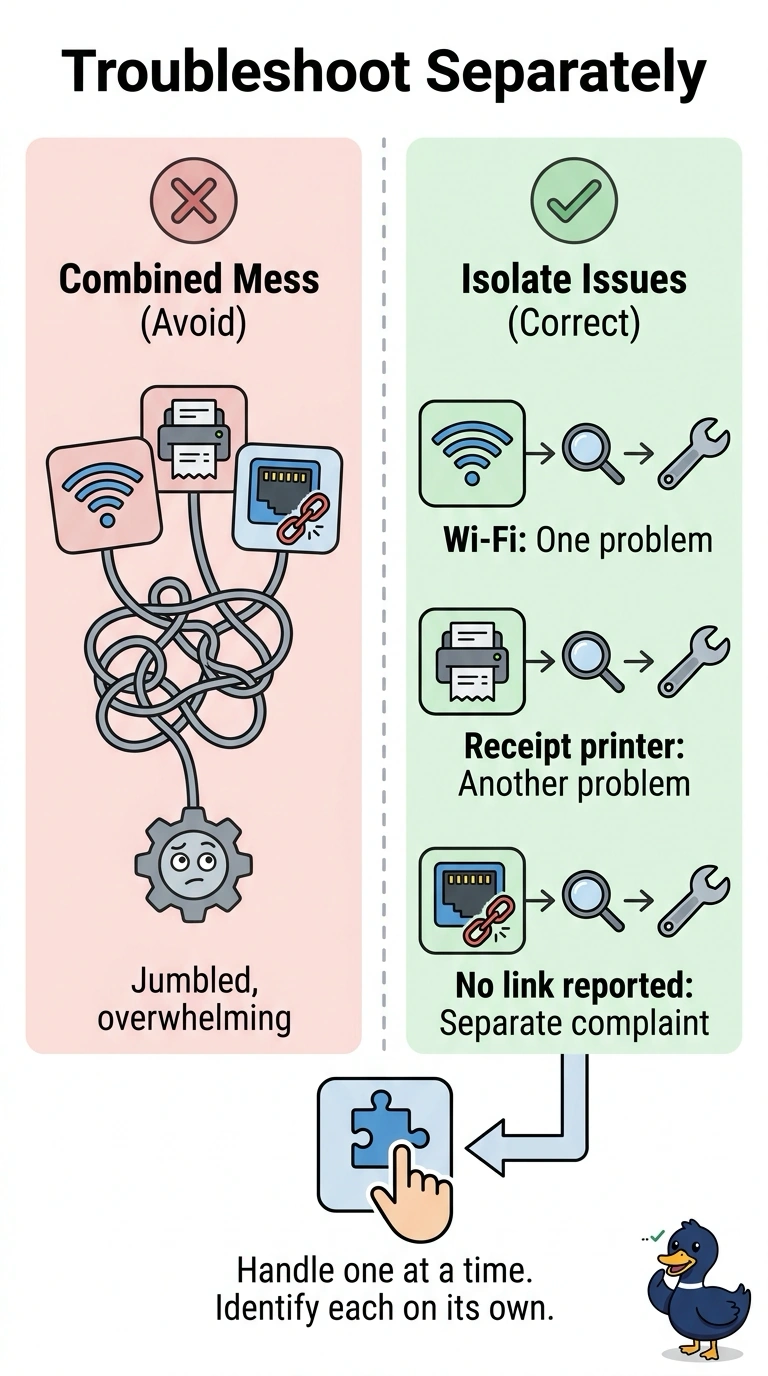
Two complaints that arrived in one sentence are still two jobs. You handle one problem at a time, identify the Wi-Fi failure on its own, and identify the paper jam on its own. Inventing a single cause that ties them together, or swapping the core before you know what failed, skips the method.
Full Explanation
The troubleshooting method says to identify the problem, and when a user reports more than one problem they are handled one at a time. The Wi-Fi outage and the jammed receipt printer share a sentence and share no stated evidence. Each gets its own identification, its own theory, and its own test. Building one theory that the paper jam caused the Wi-Fi outage invents a link the report does not contain. A jam can stop printing, and it does not, by itself, take down the radio. That theory would send the technician into the printer while wireless clients stay offline. Replacing the core switch is an implementation step aimed at hardware nobody has implicated. It risks the rest of the store to chase two complaints that may be a dead access point and a crumpled receipt. Skipping identification and changing settings first means there is no baseline and no definition of done. Either complaint can be made worse while the other is ignored. Exam caveat: one at a time does not mean ignoring a second outage until tomorrow. It means each problem is tracked, and the order can follow impact, with the Wi-Fi outage ahead of a single jammed printer if the store cannot sell. Operational check: open two notes, record the symptoms of the Wi-Fi failure and of the jam separately, and close each only when that one symptom is fixed.