
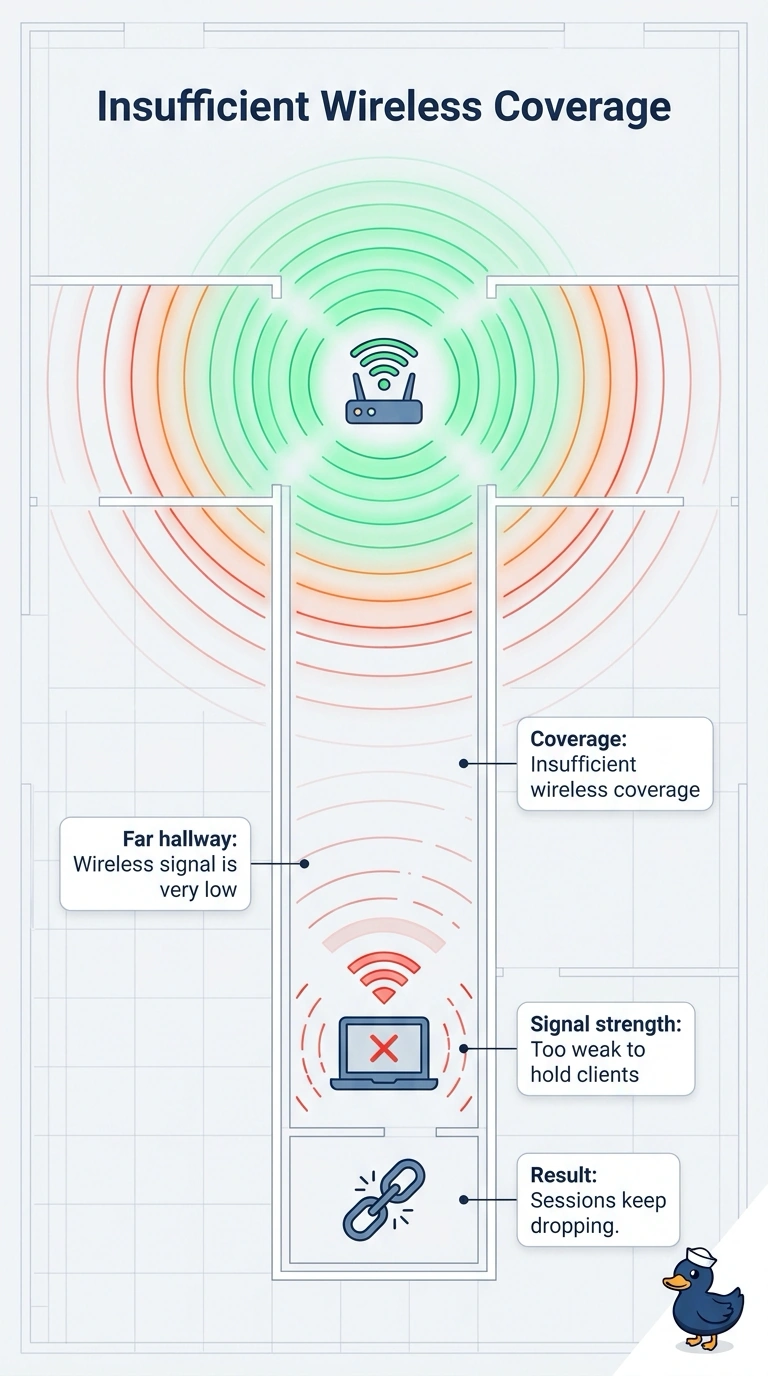
At the far hallway of a warehouse, laptops show a very low wireless signal, the channel has no overlap with neighboring networks, and sessions keep dropping. Which problem fits those readings?
Select an answer to reveal the explanation.
Short Explanation
A weak flashlight does not get brighter just because the hallway is empty of other lights. You’re seeing a very low signal and drops at the far end of the warehouse, so coverage does not reach that spot. A wider channel, co-channel interference the readings do not show, or a roam between two strong cells does not explain the weak signal.
Full Explanation
Clients drop when the signal is too weak to hold the session, so the readings point to insufficient wireless coverage at the far end of the warehouse. The channel is free of overlap, which makes contention with a neighboring network a poor fit; the access point simply does not provide a usable signal at that spot. Widening the channel bonds more spectrum, but it does not rescue a client that can barely hear the radio. Co-channel interference is a tempting explanation because a crowded channel can contribute to drops, but the question states that the channel has no overlap with neighboring networks. A roaming failure also does not fit: roaming between cells requires the client to hear more than one usable cell, whereas the hallway has a signal that is already too weak. Exam caveat: raising transmit power without a survey can create overlap elsewhere, so do not assume that more power is the right fix. Practical check: measure signal at the hallway at laptop height, then add or relocate coverage and confirm that a client can hold a session there without creating new overlap. Survey the hallway, not just the access point, before deciding the coverage hole is closed.