
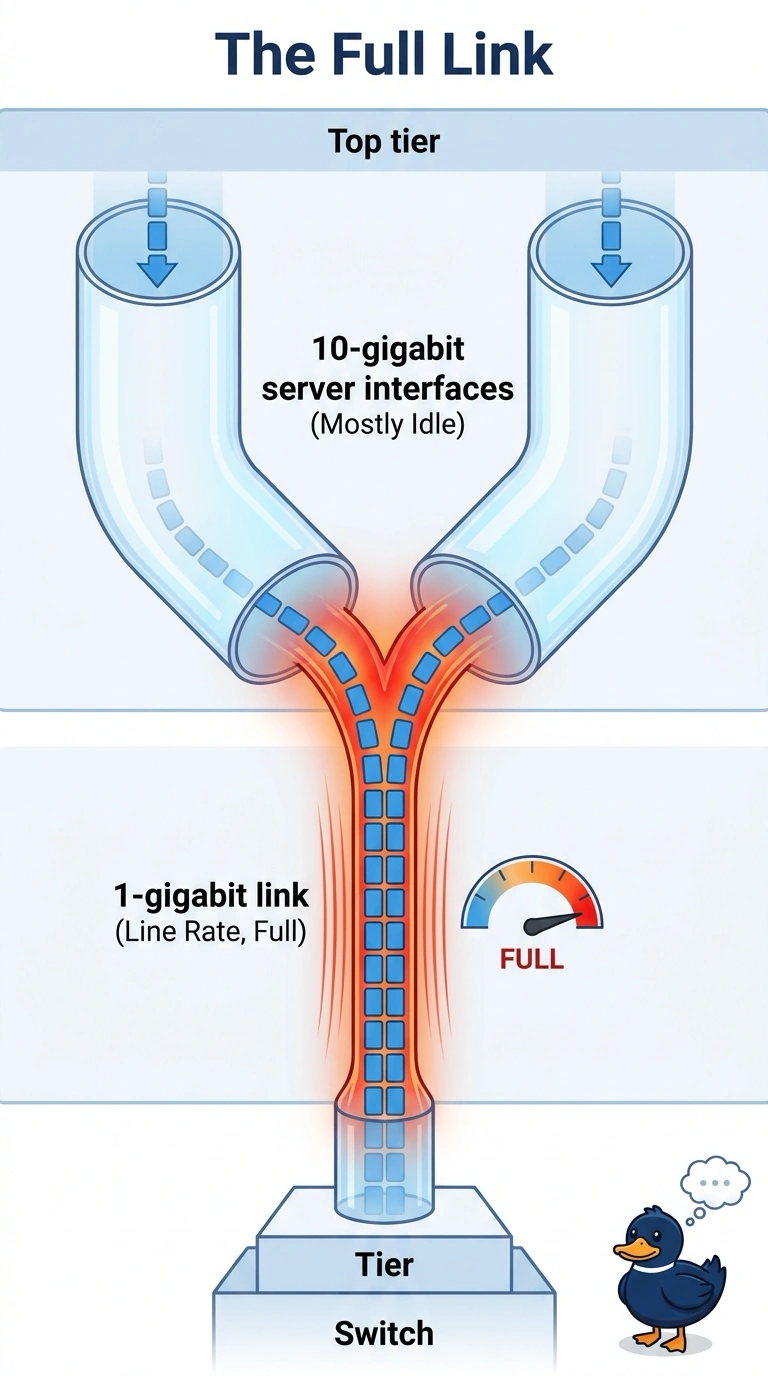
Two application tiers in a data center have 10-gigabit server interfaces. The link between the tiers is 1 gigabit, that link sits at its line rate, and the server interfaces stay mostly idle. Where is the bottleneck?
Select an answer to reveal the explanation.
Short Explanation
The narrow door in the middle of a wide hall is the thing everyone is stuck behind. You can see the 1-gigabit link sitting at line rate while the 10-gigabit server interfaces are mostly idle, so the bottleneck is that slower link. Idle interfaces, delay on those idle interfaces, or loss on interfaces that are not busy does not move the narrow hop.
Full Explanation
A bottleneck is the hop that is saturated while the rest of the path still has room. The server interfaces are 10 gigabit and mostly idle, so they are not out of capacity. The link between the tiers is 1 gigabit and sits at line rate, which means traffic is queuing there. Calling the idle interfaces the bottleneck reverses the evidence. Idle means they are waiting. Latency on those interfaces is the tempting twin because a full link makes transfers feel slow. The delay is a symptom of the 1-gigabit hop, and the idle interfaces are not the part that is full. Packet loss on the server interfaces would show those interfaces busy or dropping. The stem shows them mostly idle. Exam caveat: line rate proves that link is full. It does not by itself choose between a faster link and moving a heavy flow. Operational check: identify the conversations on the 1-gigabit link while it is full, confirm the server interfaces stay well below 10 gigabits, and retest after that link is no longer the narrow hop.