
A campus uses switches from several vendors. Which neighbor-discovery protocol will show the next switch's name and the port this switch is attached to?
Select an answer to reveal the explanation.
Short Explanation
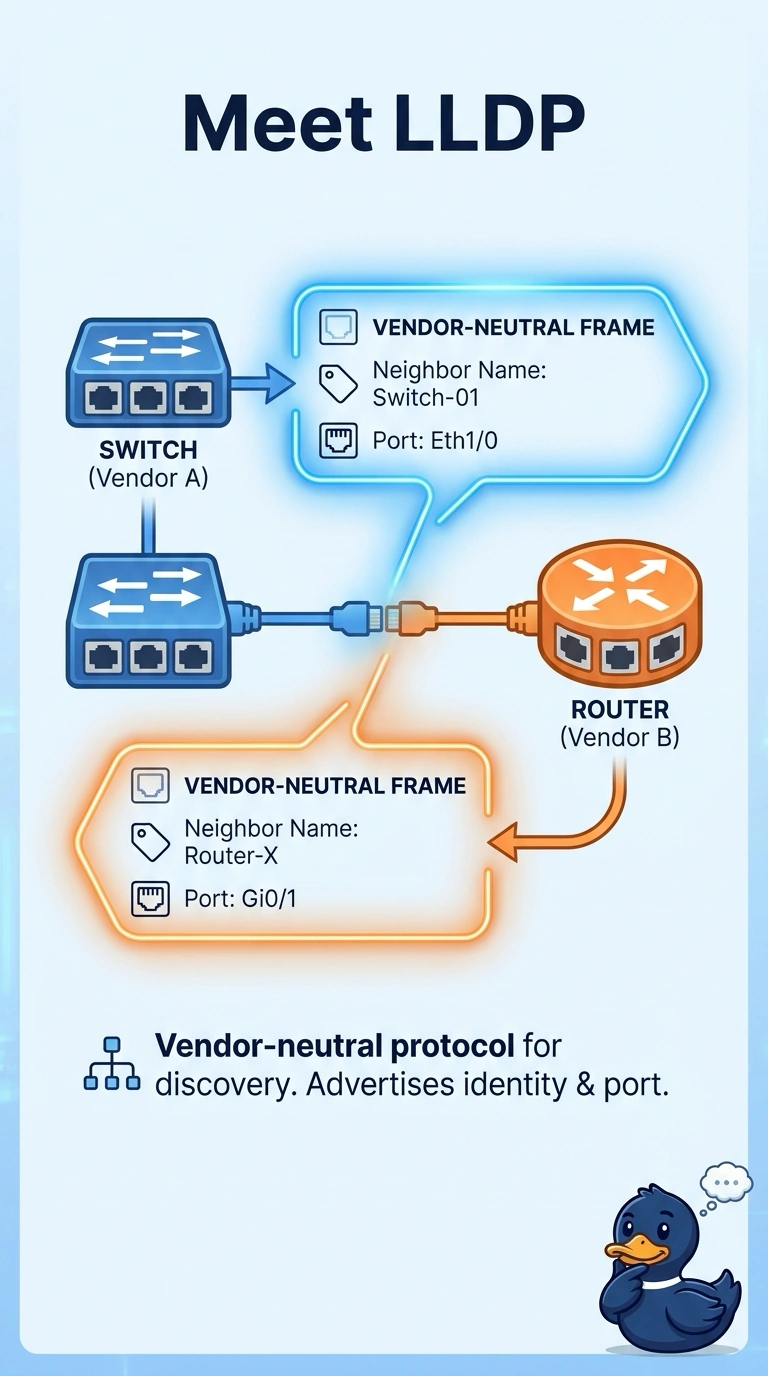
On a street with more than one brand of sign, you need the sign every brand agreed to print. You want the next switch's name and port on a mixed-vendor campus, and that advertisement is LLDP. One vendor's private discovery protocol, a routing hello, or a poll of an address you already know does not give you that neighbor on every switch.
Full Explanation
Link Layer Discovery Protocol is the IEEE neighbor-discovery protocol. Switches that speak it advertise the system name and the port to the directly connected neighbor, regardless of vendor. A mixed campus can use it to show the next switch's name and the port this switch is attached to. Cisco Discovery Protocol does a similar job and is a single-vendor protocol. Treating it as vendor-neutral is the trap, because a neighbor that does not speak it stays invisible. A routing hello names a router on a link. It does not advertise the switch port this cable uses. SNMP can poll a device whose address you already have. It does not discover the neighbor and the port by itself. Exam caveat: both ends have to have LLDP enabled. A switch that supports it and has it off looks the same as a switch that is not a neighbor. Operational check: enable it on both ends and confirm each switch displays the other's system name and the specific port. A routing hello on the same link is not a substitute for that port advertisement.