
Existing hotel phones keep their addresses. New phones come up with 169.254 addresses, and the DHCP scope shows zero free addresses. Which cause fits?
Select an answer to reveal the explanation.
Short Explanation
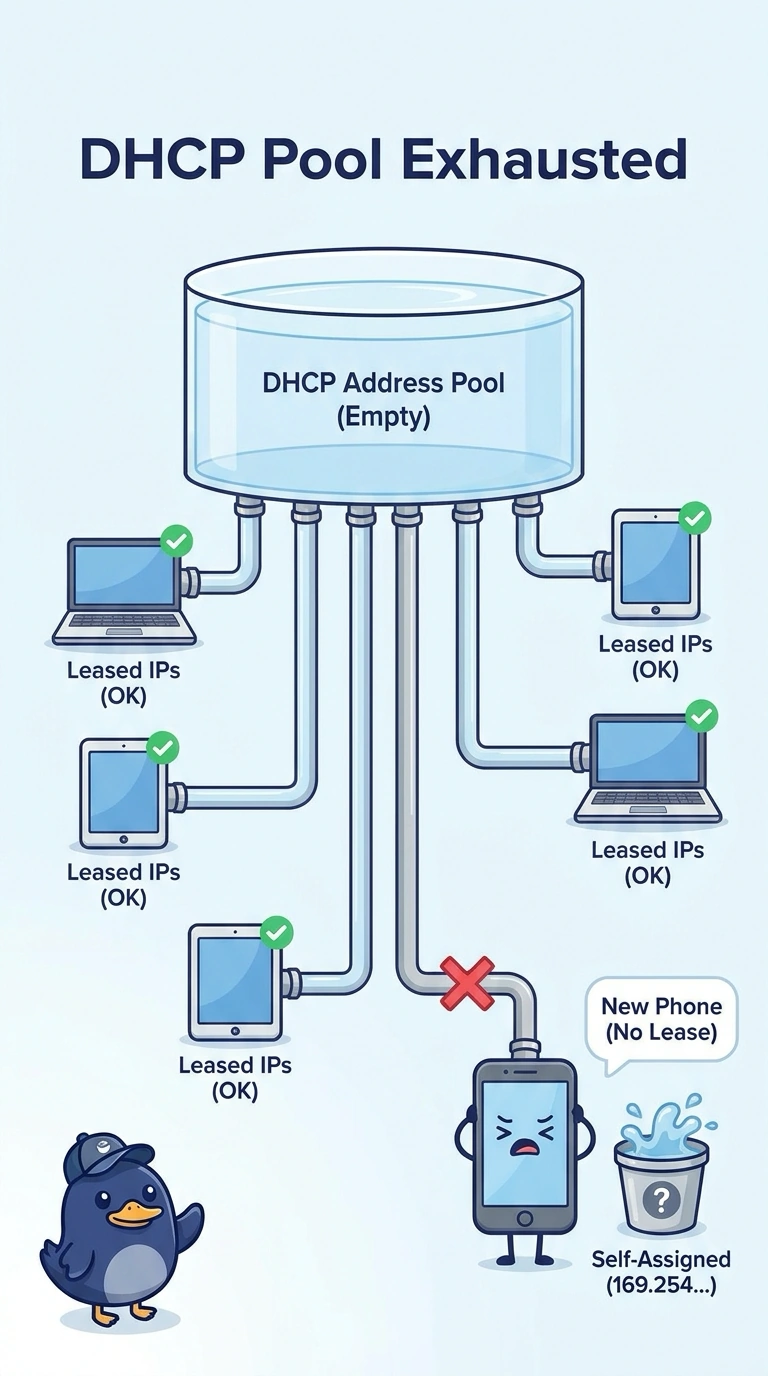
You can picture the address pool as a lot with no numbered spaces left: the next phone cannot get a lease and falls back to 169.254. Your existing phones keep their leases, while the scope shows zero free addresses, which points to pool exhaustion. A wrong VLAN on every phone port, a missing DHCP helper, or duplicate addresses does not explain the scope reporting no free addresses.
Full Explanation
When a DHCP scope has no free addresses, the server cannot offer a lease. Existing phones keep the leases they hold, which is why they still have addresses. A new phone that gets no offer assigns itself an address in 169.254.0.0/16. The zero-free-address count is evidence of exhaustion: the address pool is full, so new phones cannot obtain a lease. A wrong VLAN on every phone port could prevent phones from reaching the expected network, but it would not leave the existing phones on their current addresses as described. A missing DHCP helper is a tempting explanation because new phones might also fail to receive a lease; however, it would not by itself drive the scope’s free-address count to zero. Duplicate addresses cause a conflict after a lease is assigned, not a scope that reports zero free addresses. Exam caveat: stale leases for devices that are gone can fill a scope, so clearing them may be part of recovery. Practical check: display the scope and confirm zero free addresses, reclaim stale leases or expand the pool, then verify that a new phone receives a hotel address instead of 169.254.