
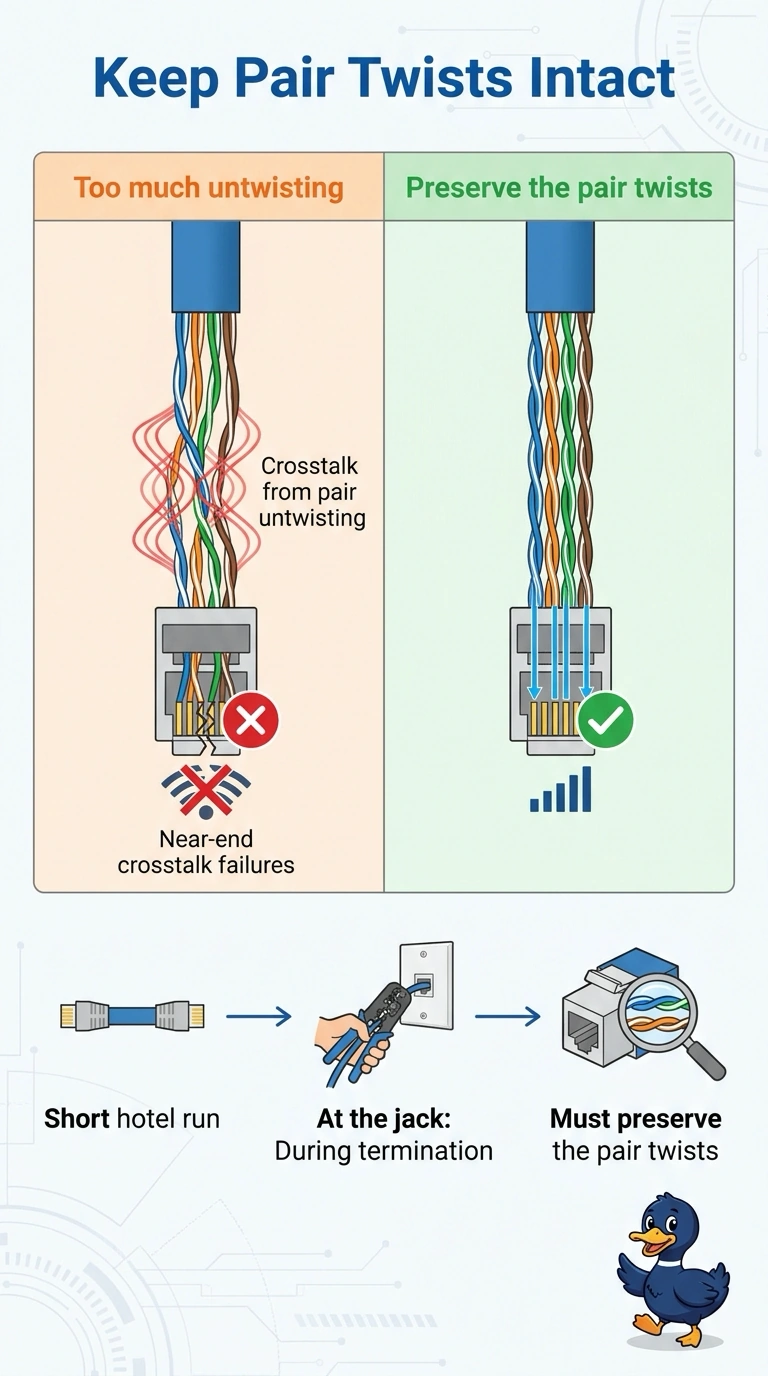
A certification tester reports near-end crosstalk failures on a short hotel run. The installer untwisted several centimeters of each pair at the jack. Which cause fits?
Select an answer to reveal the explanation.
Short Explanation
You’ve found the key clue: untwisting several centimeters at the jack disrupts the pair balance and causes crosstalk. That fits the near-end crosstalk failure on a short run; excessive length, connector reflection, and interference from a neighboring bundle do not match the reported failure.
Full Explanation
Near-end crosstalk is unwanted coupling from one pair into another, measured near the transmitter. The twist limits that coupling. Untwisting several centimeters at the jack disrupts the pair balance at the termination, so the short hotel run can fail even though length is not the issue. Attenuation from excessive length does not fit: attenuation grows with distance, and the reported failure is near-end crosstalk, not loss. Return loss from a bad connector is a plausible separate failure, since it measures reflection, but it does not explain the near-end crosstalk result. Alien crosstalk comes from a neighboring bundle; here, the reported cause is the pairs untwisted at the jack, not the adjacent bundle. Exam caveat: keep the untwisted length to what the connector requires. Reterminating with the twists intact addresses the stated cause; replacing a short run is not indicated by this result. Practical check: reterminate the jack, run the certification test again, and confirm near-end crosstalk passes. If return loss was also failing, correct that connector after restoring the twist.