
Replication between a city agency and a site on another continent shows a steady 180-millisecond delay and almost no loss. Transfers feel slow, and loss counters stay near zero. Which impairment is this?
Select an answer to reveal the explanation.
Short Explanation
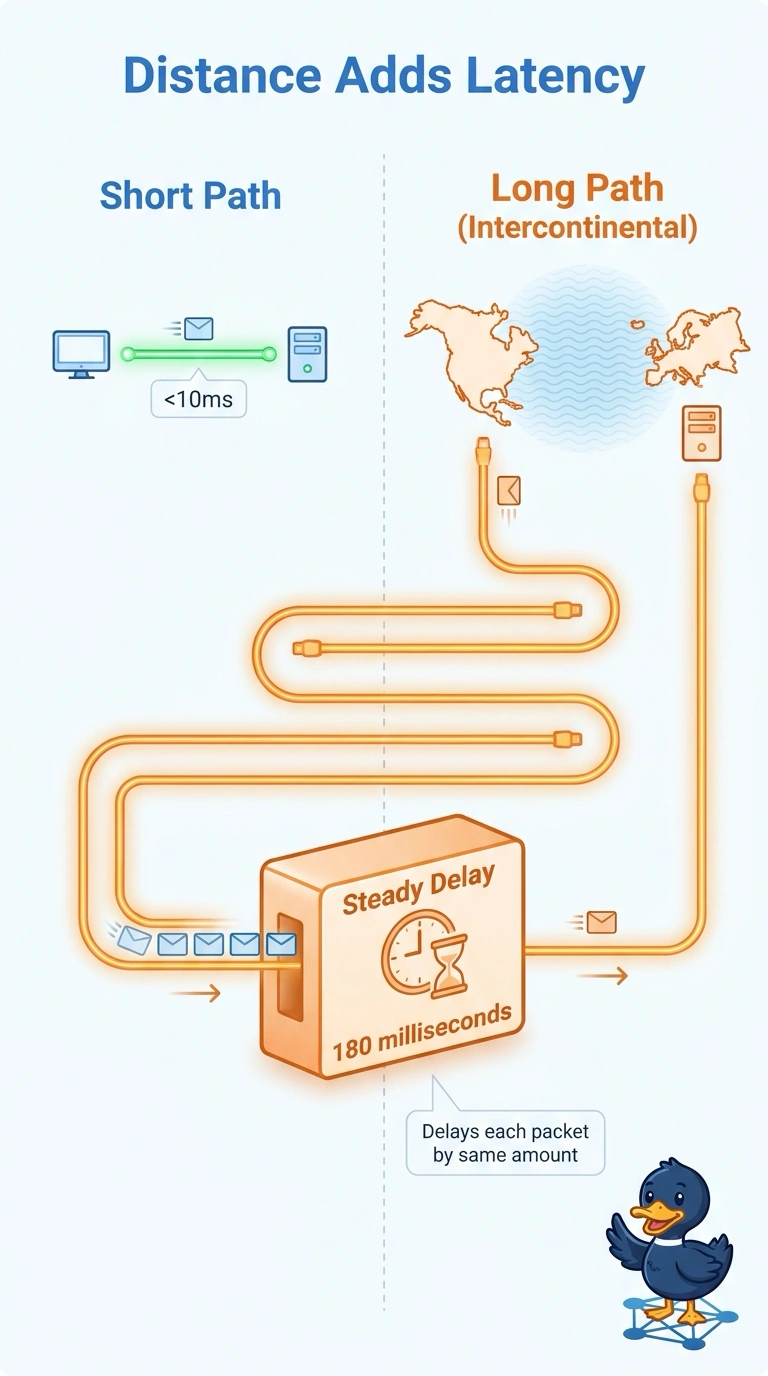
A long flight is slow even when every suitcase arrives. You are seeing a steady 180-millisecond delay and almost no loss, which is latency, so transfers feel slow because every packet waits out the distance. Delay that stays steady is not jitter, and loss or a full circuit would show up in the counters that are sitting near zero.
Full Explanation
Latency is the delay before a packet arrives. A path between continents has a propagation delay, and this replication shows it as a steady 180 milliseconds with almost no loss. Transfers feel slow because each round trip waits, and the packets are still arriving. Jitter is variation in that delay. A delay that holds steady is the opposite pattern, so naming it jitter misreads a flat measurement. Packet loss is the tempting cause of a slow transfer. The stem says the loss counters stay near zero, so the copies are waiting, not being discarded. A bandwidth shortage fills the circuit and then drops or queues until loss appears. A steady delay with clean counters is the distance, not a saturated link. Exam caveat: latency and a little jitter can exist together. When the delay is steady and the counters are clean, latency is the finding. Operational check: measure delay at several times of day, confirm it stays near 180 milliseconds without loss spikes, and size the replication window for that delay.