
A warehouse host is addressed 10.1.1.10 with mask 255.0.0.0. It sends an ARP for 10.2.2.2 instead of forwarding that packet to its gateway. The mask should be 255.255.255.0. Why does it ARP?
Select an answer to reveal the explanation.
Short Explanation
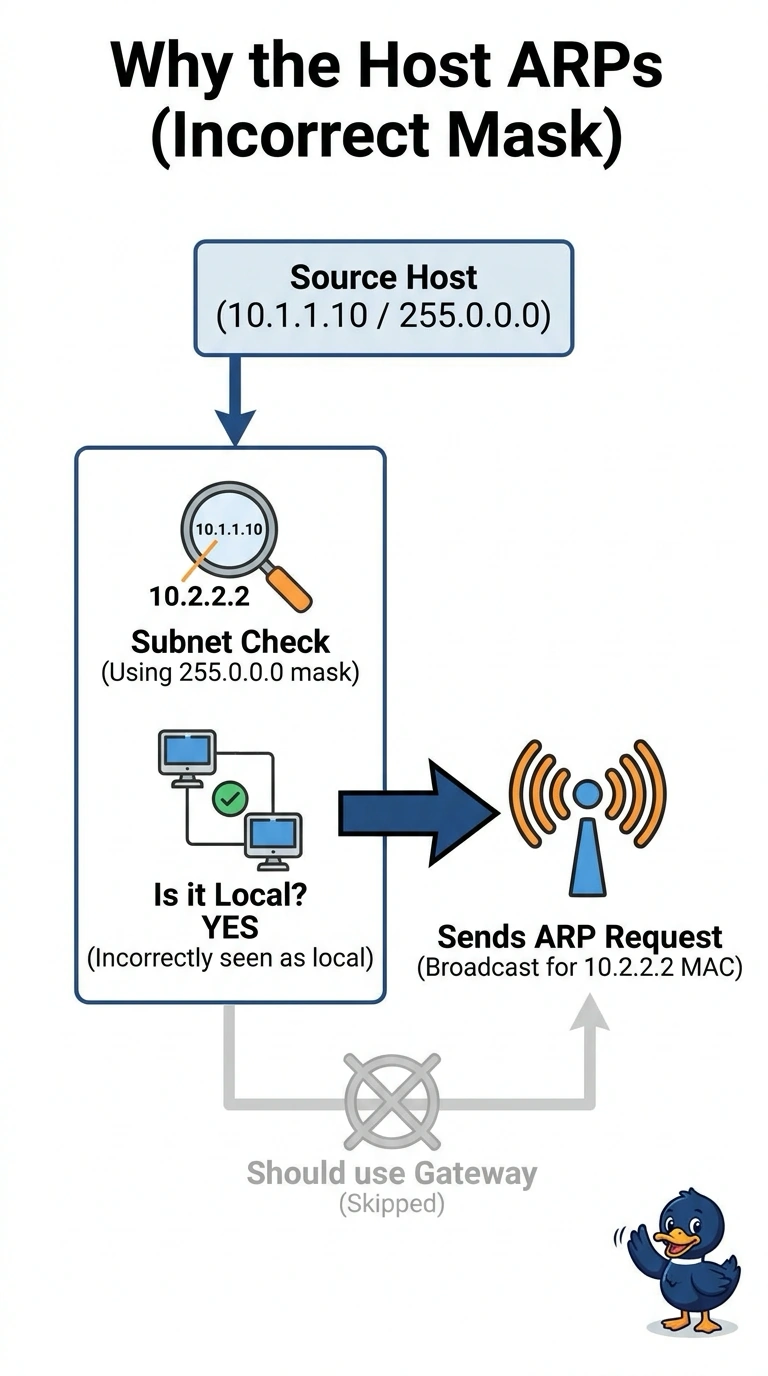
The mask is the fence around your block, and this fence was drawn around the whole 10 network. You sit at 10.1.1.10 with 255.0.0.0, so 10.2.2.2 looks like a neighbor and the host ARPs for it instead of handing the packet to the gateway. A longer mask would have sent that packet to the gateway.
Full Explanation
A host compares the destination with its own address under the subnet mask. If the masked portions match, it treats the destination as local and sends ARP. The warehouse host is 10.1.1.10 with 255.0.0.0, a /8. Both addresses fall inside 10.0.0.0/8, so the host ARPs for 10.2.2.2. The intended mask, 255.255.255.0, is a /24. Under that mask 10.2.2.2 is not local, and the host would use its gateway. The mask is too short. Calling it too long reverses the test. A longer mask makes more destinations look remote, and a remote destination is handed to the gateway rather than resolved with ARP. A missing gateway matters only after the host has decided the destination is remote. This host never makes that decision, so a gateway could be present and the ARP would still go out. Proxy ARP is a router answering an ARP for a remote host. It can hide a mask problem after the ARP is sent. It is not why the host sent the ARP. Exam caveat: a mask that is too long creates the opposite symptom, a local neighbor sent to the gateway. Operational check: set the mask to 255.255.255.0, confirm the ARP for 10.2.2.2 stops, and confirm the packet is directed at the gateway's MAC address.