
A factory branch router can ping every internal subnet listed in its routing table and cannot reach any internet address. The table contains no 0.0.0.0/0 entry. Which omission explains the internet failure?
Select an answer to reveal the explanation.
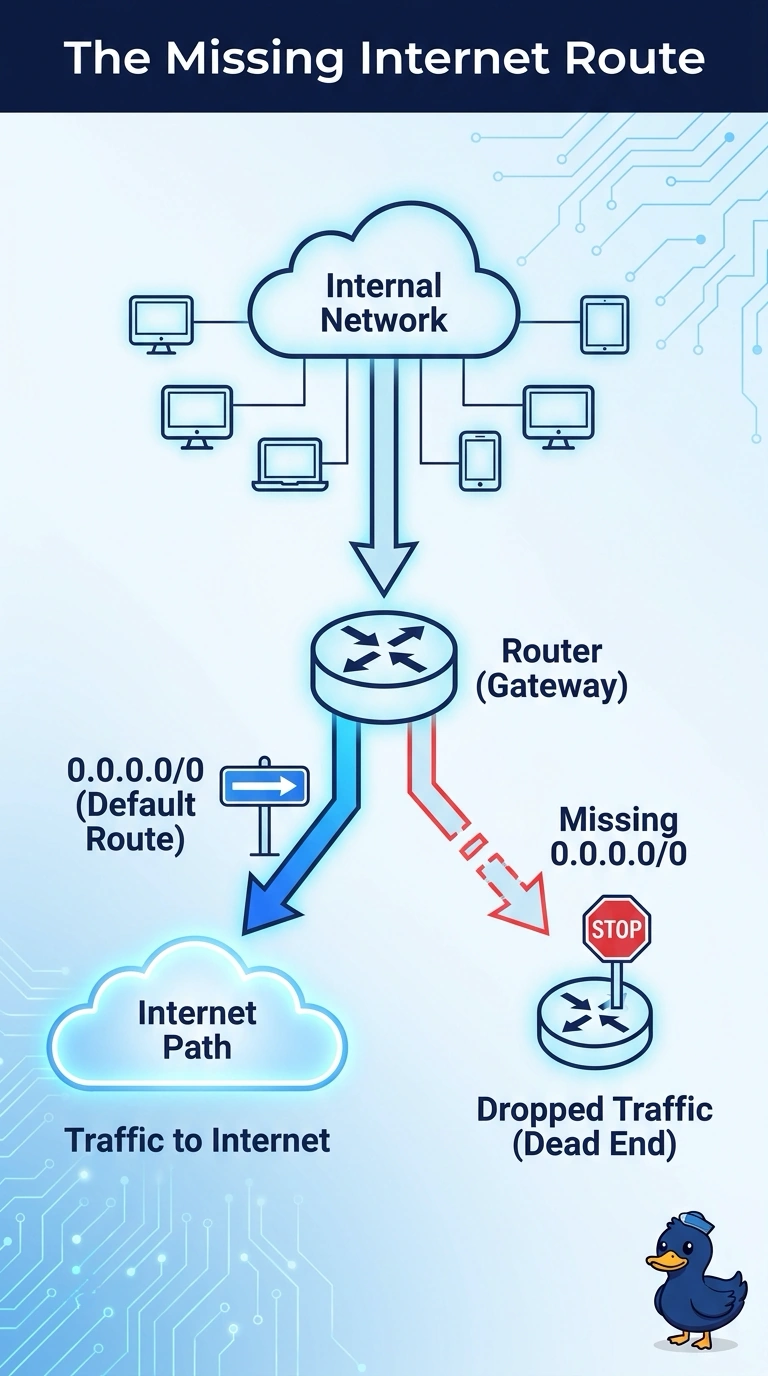
Short Explanation
The router already knows every street inside the factory, which is why those pings work. You are asking it for the highway, and the table has no default route, the 0.0.0.0/0 entry that means everywhere else. A next hop that is down would still leave that line in the table, and translation never gets a packet the router cannot forward.
Full Explanation
A router forwards a packet by the longest matching prefix in its table. Every internal subnet the factory uses has such a prefix, and the branch router can ping those networks, so its interfaces, masks, and internal routes are doing their jobs. Internet destinations match the default route, written 0.0.0.0/0. That entry is absent, so the router has nowhere to send public addresses. A mask that was too short would disturb internal forwarding. Internal pings succeeding argue against that fault. A default route with a dead next hop is the tempting twin, because the internet would also fail, and the stem says the table contains no 0.0.0.0/0 line at all. A down next hop does not delete the route from the table. Address translation can be required before private sources are accepted on the public path, and it never forwards a packet the router has no route for. The missing route is the gap the table shows. Exam caveat: after the default route is added, a separate translation problem can still block the internet. Fix the route the stem names first. Operational check: display the routing table, confirm 0.0.0.0/0 is missing, install a default route toward the provider next hop, and ping a public address only after that entry appears.