
A new ceiling access point never powers on. Its data sheet requires 20 watts at the access point, and the switch port only offers IEEE 802.3af. Which limitation explains the dark access point?
Select an answer to reveal the explanation.
Short Explanation
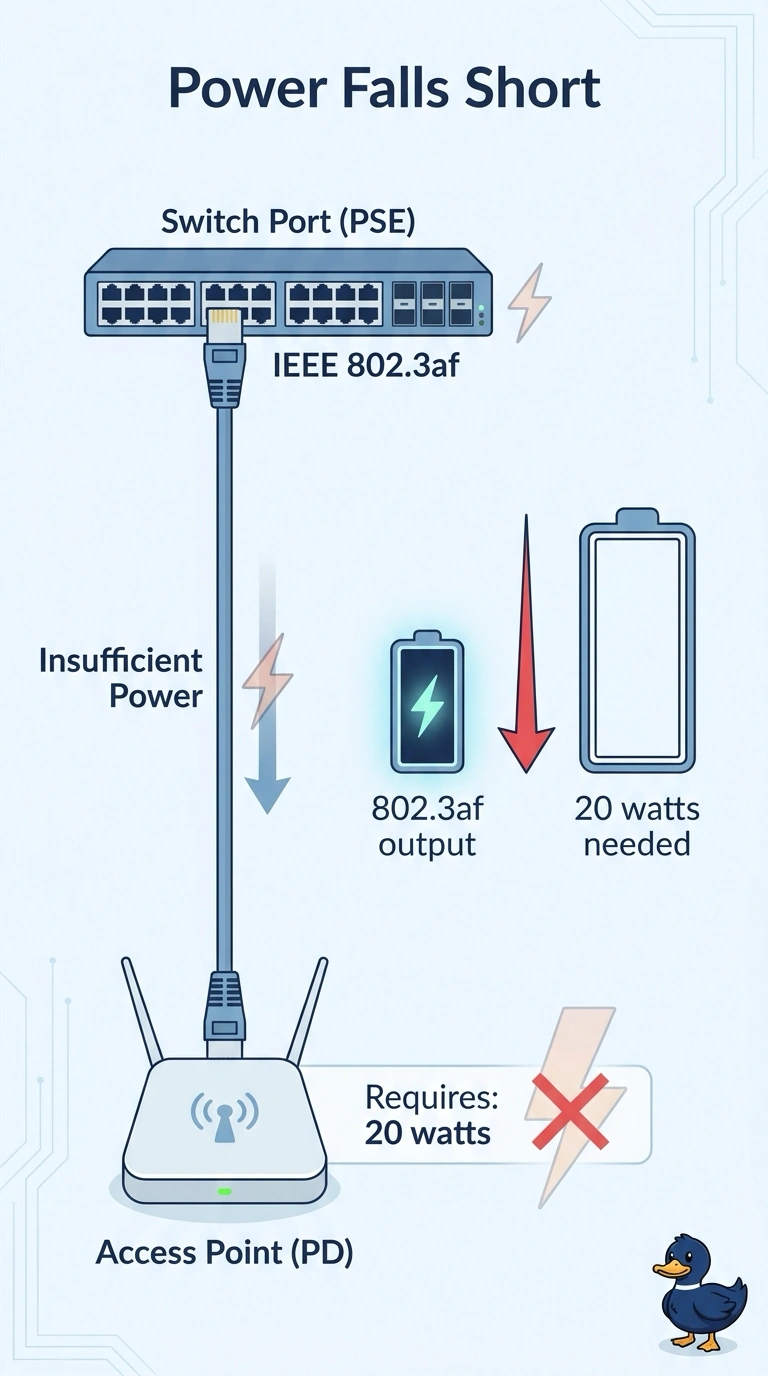
You’ve found the key issue: 802.3af provides less power at the access point than its 20-watt requirement. 802.3at can cover that requirement after cable loss, 802.3bt is not needed, and a port offering 802.3af is not simply a port with PoE disabled.
Full Explanation
IEEE 802.3af supplies up to 15.4 watts at the switch port and 12.95 watts at the powered device after cable loss. Since the access point needs 20 watts at the device, an 802.3af port falls short and cannot power it; this is the limitation that explains the dark access point. The claim that 802.3at still leaves less than 20 watts at the device is incorrect: 802.3at provides up to 30 watts at the port and 25.5 watts at the device, enough for this access point. The claim that 802.3bt is required because anything above 15 watts exceeds 802.3at is also incorrect; 802.3at supports up to 25.5 watts at the device, while 802.3bt serves higher-power needs. PoE disabled is a different fault: the described port offers 802.3af, so the issue is that its offered standard cannot meet the device’s requirement, not that power is turned off. Exam caveat: an 802.3at port can still fail to power the access point if the switch’s total PoE budget is exhausted. Practical check: verify the port’s offered standard and remaining power budget, then test the access point on a port with 802.3at or better and sufficient budget before troubleshooting network settings.