
A cable tester on a new city-hall desk run reports split pairs and high crosstalk, and gigabit will not link. The run is about 20 meters, and the pairs were untwisted and punched onto the jack. Which fault fits those results?
Select an answer to reveal the explanation.
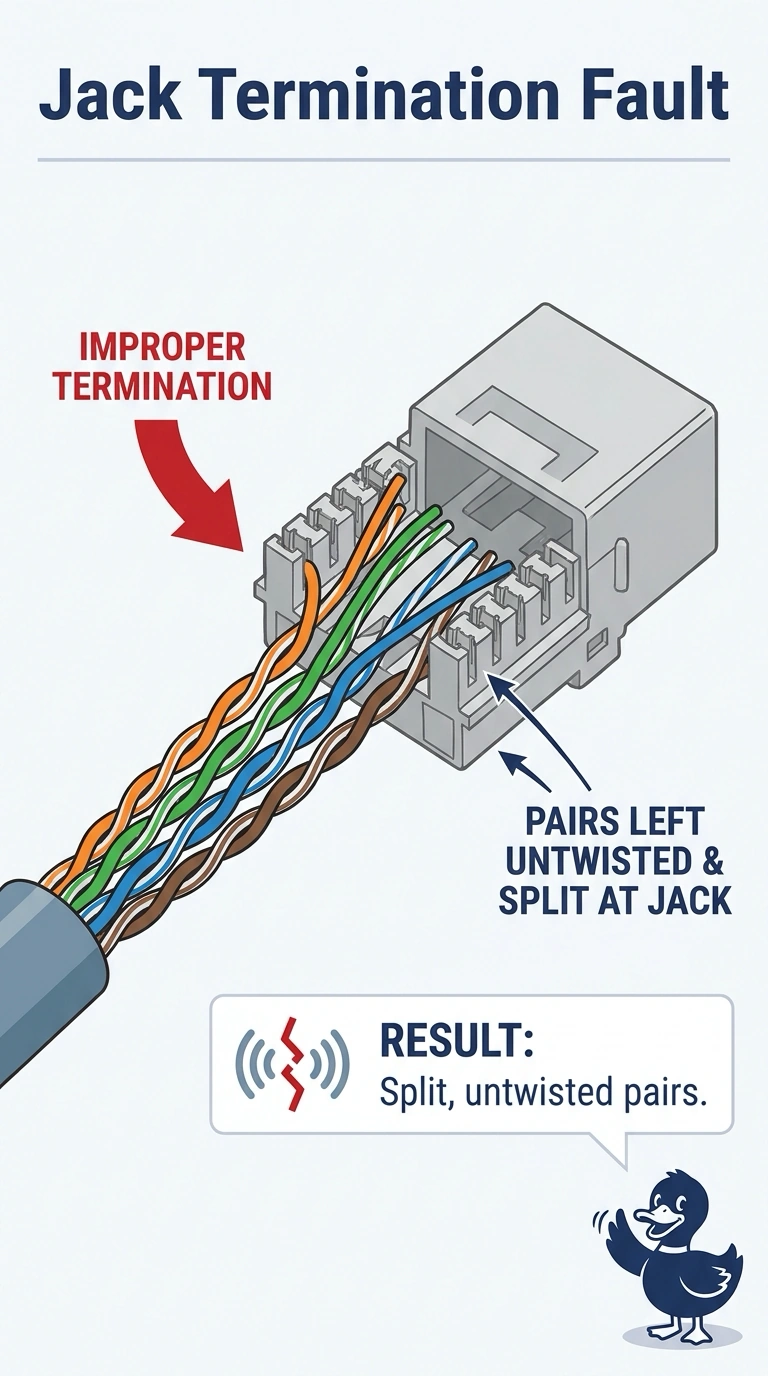
Short Explanation
Think of the twists as noise-canceling protection: when you untwist the pairs and punch them onto the jack incorrectly, you can create split pairs and high crosstalk. You can rule out a reversed pair because the tester would name that differently, and a 20-meter run is not too long for gigabit; a nearby ballast would not make the wire map report split pairs.
Full Explanation
Split pairs and high crosstalk point to improper termination: the conductors were untwisted and punched onto the jack so the pairs no longer remain balanced on their intended pins. That disrupts the twists’ ability to limit interference and can prevent gigabit from linking. A reversed pair is a different wire-map result; the tester would identify that condition rather than report split pairs. Attenuation can limit a link when a cable run exceeds its supported distance, but 20 meters is well within the 100-meter Ethernet channel limit, so length does not fit these results. Interference from a nearby ballast can affect transmission, but it would not cause a wire map to identify split pairs at the jack. Exam caveat: high crosstalk alone does not prove that the jack termination is the cause, but the reported split pairs together with the known untwisting and punching make improper termination the best fit here. Practical check: re-terminate the jack with the twists maintained as close to the termination as possible and each pair on its correct pins, then run the cable test again and confirm that the split-pair and excess-crosstalk results are gone.